沏
Character Story & Explanation
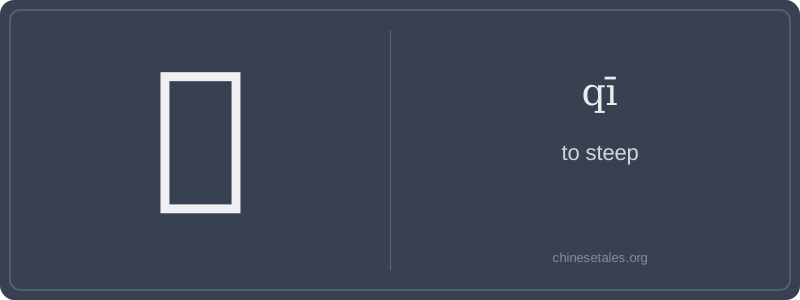
The earliest trace of 沏 appears in seal script (c. 3rd century BCE), where it combined 氵 (water radical) on the left with 七 (qī, ‘seven’) on the right — no pictograph of tea leaves or pots. Unlike many characters born from pictures, this one was created *phonetically*: 七 provided both sound and symbolic resonance. Ancient tea masters believed optimal steeping required precise timing — often counted in breaths or rhythmic chants, and ‘seven’ carried auspicious, harmonious connotations in Daoist and cosmological thought, suggesting balance between water, leaf, heat, and time.
By the Tang dynasty, with Lu Yu’s The Classic of Tea canonizing preparation methods, 沏 became the standard written verb for the core steeping step — distinct from washing leaves (洗茶) or roasting (焙). Its modern form solidified in regular script: three water dots (氵) visually anchor the character in liquid, while the clean, angular 七 (7 strokes total!) evokes precision — seven strokes, seven breaths, seven seconds. Even today, experienced tea servers may literally count ‘one… two…’ up to seven before pouring off the first infusion.
Think of 沏 (qī) as the gentle, precise verb for coaxing flavor out of tea leaves — not boiling, not brewing like coffee, but *steeping*: letting hot water patiently draw out aroma and essence. It’s a quiet, intentional action tied to Chinese tea culture’s reverence for timing, temperature, and attention. You’ll almost always see it in the pattern ‘沏 + noun’, like 沁茶 (qī chá) — and it’s strictly transitive: you *must* specify what you’re steeping (no ‘I’m going to qī’ alone!).
Grammatically, it behaves like other single-syllable action verbs: it can take aspect particles (沏了, 正在沏, 沏过), appear in serial verb constructions (先洗杯子,再沏茶), or serve as the main verb in simple sentences. A common mistake? Using it for coffee or herbal infusions — while possible in casual speech, native speakers reserve 沏 overwhelmingly for *tea*, especially loose-leaf varieties. For instant tea bags or coffee, they’d use 泡 (pào) instead.
Culturally, 沏 carries subtle weight: offering someone freshly 沏的茶 signals respect and care — the act itself is part of hospitality. Learners sometimes overuse it, applying it to any hot drink, but its nuance lies in that slow, deliberate extraction. Also watch the tone: qī (first tone) is easily mispronounced as qǐ (third tone), which means ‘to rise’ — imagine telling your host ‘I’ll rise the tea’ instead of ‘I’ll steep it’!