沕
Character Story & Explanation
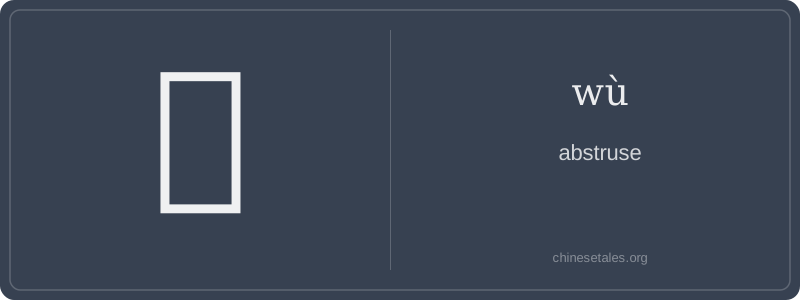
The earliest form of 沕 appears in bronze inscriptions as a combination of 氵 (water radical) and 忽 (hū, 'suddenly vanish'). Visually, it wasn’t a picture of water itself, but of water receding *into darkness* — imagine ink dissolving into black silk, leaving no trace. Over time, 忽 simplified: its top 古 became ⺈ (a slanted stroke), and its bottom 心 lost its dot, becoming 必-like. By the Han dynasty clerical script, the right side had stabilized as the modern 忄+勿 structure — a visual metaphor for 'mind vanishing without warning.'
This evolution mirrors its semantic journey: from 'to disappear suddenly' (early meanings in *Shuōwén Jiězì*) to 'profoundly concealed' — especially in Daoist cosmology, where the Dao’s primordial state is described as 沕然 (wù rán): undifferentiated, unmanifest, yet pregnant with all things. Li Bai used it in a line about mist-shrouded mountains — not just foggy, but *essentially unknowable*. The water radical isn’t about liquidity; it’s about depth, flow into the unseen — like the subconscious mind in Jungian terms, or Plato’s cave’s deepest shadow.
Think of 沕 (wù) as the Chinese equivalent of the word 'esoteric' — not just 'hard to understand,' but deliberately veiled, like a secret society’s handshake or an alchemist’s coded manuscript. In Classical Chinese, it conveys profound obscurity: something hidden not by accident, but by nature — deep, silent, and almost reverent in its concealment. It’s never used casually; you won’t hear it in daily chat or textbooks — it lives in philosophical essays, Tang dynasty poetry, and Daoist texts describing the ineffable origin of the cosmos.
Grammatically, 沕 is almost always an adjective, but unlike modern adjectives like 简单 (jiǎndān), it rarely stands alone. It prefers elegant compound forms — especially with 深 (shēn, 'deep') or 隐 (yǐn, 'hidden') — and often modifies abstract nouns: 沕深之理 (the abstruse principle), 沕然不显 (so obscure it remains unseen). Learners mistakenly try to use it like 奇怪 (qíguài) or 难懂 (nándǒng), but that’s like calling quantum physics 'weird' — it flattens its poetic gravity.
Culturally, 沕 carries Daoist and Xuanxue (Neo-Daoist metaphysical) weight — evoking the *nameless* Dao (《道德经》: '道可道,非常道'), where true reality is fundamentally elusive. A common mistake is misreading it as wū or mù — but the tone is sharp and falling (wù), like a stone dropping into deep water. Also, don’t confuse it with 没 (méi/mò) — same radical, totally different world: one erases existence, the other guards mystery.