沭
Character Story & Explanation
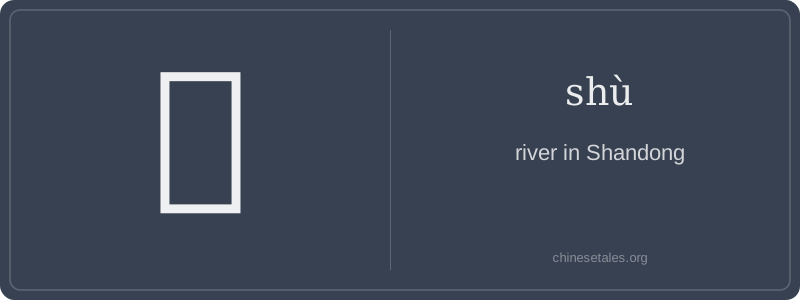
The earliest form of 沭 appears in Warring States bamboo slips (c. 475–221 BCE), not oracle bones — it’s too young for that. Its structure is clear from the start: left side 氵 (three-dot water radical), right side 朮 (shù, an ancient variant of 术, meaning ‘art’ or ‘method’, but here purely phonetic). The three dots were originally three wavy lines — literal flowing water. The right-hand 朮 evolved from a pictograph of a tree with roots and branches, later stylized into its modern form; by Han dynasty, it was fully standardized as the phonetic component guiding pronunciation.
Historically, 沭 named only the Shu River — mentioned in the Classic of Mountains and Seas (Shānhǎi Jīng) as a tributary feeding the Huai River system. Its meaning never broadened: unlike 河 (river) or 江 (Yangtze-like river), 沭 never became generic. The character’s visual logic is elegant: water (氵) + sound (朮 → shù) = a river whose name sounds like ‘shù’. No metaphor, no abstraction — just geography encoded in ink.
沭 (shù) is a quiet, place-name character — not a verb or adjective you’ll use in daily chat, but one that anchors real geography in Shandong province. Its core feeling is *liquid specificity*: it names a real river (the Shu River), so it carries the cool, steady presence of water + location. You won’t say ‘I shù’ or ‘very shù’ — it only appears in proper nouns: river names, county names (like 沭阳县 Shùyáng Xiàn), and occasionally surnames. Think of it like ‘Thames’ in English — meaningful only in context, never used alone.
Grammatically, 沭 behaves like a noun root. It almost always pairs with other characters: 沭河 (Shù Hé, ‘Shu River’), 沭阳 (Shùyáng, ‘Sunlit bank of the Shu River’). Learners sometimes mistakenly treat it as a verb (e.g., *shù shuǐ* — ‘to shù water’), but no — it has zero verbal usage. It’s purely lexical ballast: stable, unchanging, and tied to land.
Culturally, 沭 is a subtle reminder that Chinese writing preserves ancient hydrology. Over 2,500 years, this river shaped agriculture, transport, and settlement — and the character kept its shape while dynasties rose and fell. A common mistake? Pronouncing it as sù (like 素) or shū (like 书). Remember: shù — sharp, single tone, like a stone dropped into still water.