沱
Character Story & Explanation
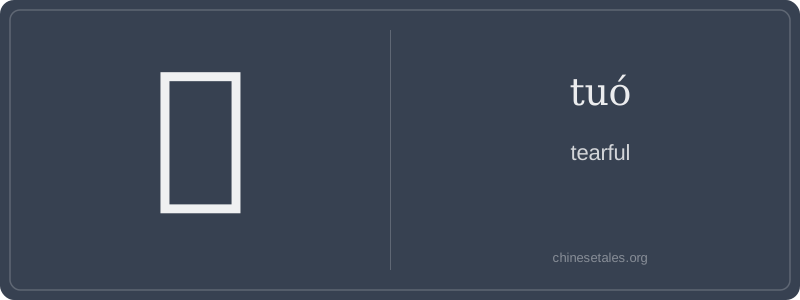
The earliest form of 沱 appears in bronze inscriptions as a flowing water symbol (氵) beside a phonetic component resembling 'it' or 'that' (它, tā), which later simplified to '它' without the 'snake' tail. Visually, it began as three water dots + a curved, sinuous shape evoking both water’s meander and the slow, heavy roll of tears — like liquid gathering at the lower lash line before dropping. Over time, the right side condensed from 他 (tā) → 它 (tā) → 沱, while the water radical stayed anchored on the left, grounding the emotion in fluidity and gravity.
This dual origin explains its duality: 沱 first meant 'eddy' or 'slow-moving backwater' (still used in place names like 沱江, Tuó Jiāng River), but by the Tang and Song dynasties, poets seized its visual resonance — tears pooling like still water — and extended it metaphorically to describe tears themselves. In Li Qingzhao’s famous ci poem, she writes '泪痕红浥鲛绡透' — though she doesn’t use 沱, her imagery of tears soaking through silk mirrors exactly what 沱 evokes: tears not streaming, but accumulating, glistening, weighty. The character didn’t change — but Chinese poetry gave it new eyes.
Let’s be honest: 沱 (tuó) is a quiet rebel. It means 'tearful' — not just 'crying', but that deep, silent, soul-wringing kind of weeping where tears well up and hang heavy, like droplets trembling on a leaf before falling. It’s poetic, literary, and emotionally precise — think classical poetry or lyrical prose, not texting your friend about spilling coffee. You’ll rarely hear it in spoken Mandarin; it lives in written elegance.
Grammatically, 沱 functions almost exclusively as an adjective, often modifying nouns like 眼 (yǎn, eye) or 脸 (liǎn, face), and it almost always appears in reduplicated form: 沱沱 (tuó tuó). That doubling isn’t optional fluff — it’s the grammatical heartbeat. You’d say 沱沱泪 (tuó tuó lèi, 'tear upon tear') or 沱沱泪光 (tuó tuó lèi guāng, 'glistening tear after tear'). Using just one 沱? Sounds incomplete, like saying 'a sob' instead of 'sobs'. Learners often try to use it alone or with modern verbs ('I 沱'), which breaks its poetic grammar entirely.
Culturally, this character carries centuries of restrained emotion — Confucian ideals valued dignified sorrow over loud lamentation, and 沱 embodies that: tears held, gathered, visible but controlled. A common mistake is confusing it with 泪 (lèi, general 'tear') or 涕 (tì, 'nasal discharge/tears'), but 沱 is specifically *visual* and *accumulating*. Also, don’t confuse it with the homophone 沱 (tuó) meaning 'backwater' or 'eddy' (same radical, different meaning!) — context and tone mark are your lifelines.