沺
Character Story & Explanation
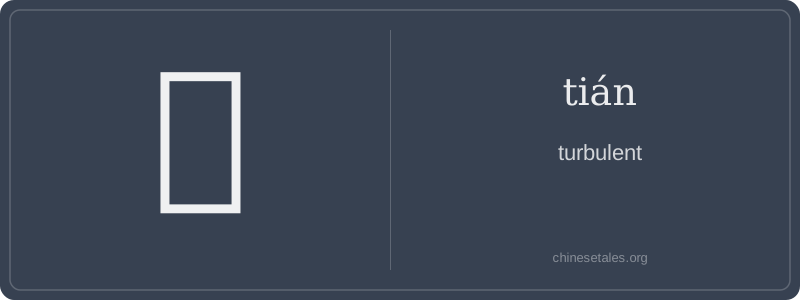
The earliest form of 沺 appears in Warring States bamboo slips as a flowing, sinuous glyph: three wavy water lines (氵) on the left, and on the right, a stylized ‘field’ (田) crossed by two diagonal strokes — representing chaotic ripples breaking across cultivated land. Over centuries, the ‘field’ simplified into today’s 田, while the water radical solidified into the standard three-dot form. The diagonals evolved into the two short slants inside 田, visually mimicking turbulent eddies cutting across orderly terrain — a brilliant visual pun encoded in ink.
This imagery shaped its semantic journey: from literal ‘water churning over farmland’ (seen in early texts like the *Chu Ci*) to metaphorical ‘disruption of harmony’. By the Han dynasty, 沺 appeared in philosophical debates about cosmic imbalance — e.g., ‘天地洏洏’ (heaven and earth in tumult) — linking hydrology to ontology. Its rarity today isn’t decline, but preservation: it’s held in reserve for moments when ordinary words fail, like a ceremonial sword kept sharp in its scabbard.
Let’s crack 沺 like a linguistic nut: it’s not just ‘turbulent’ — it’s the visceral, almost physical sensation of water churning violently, like rapids tearing apart smooth flow. Think less ‘windy’ and more ‘a river in fury’, with undertones of chaos, unpredictability, and raw natural force. It’s rare in modern spoken Mandarin but surfaces in literary, poetic, or classical contexts — never in casual chat like ‘the weather is turbulent’. You’ll spot it in phrases describing emotional upheaval (e.g., 心潮洏洏) or geological unrest (e.g., 地脉洏洏), always carrying weight and gravity.
Grammatically, 沺 functions almost exclusively as an adjective — but crucially, it *requires reduplication* (洏洏) to sound natural and idiomatic. You’ll almost never see it alone. It also appears in fixed four-character idioms (chengyu) and classical compound nouns (e.g., 洏流, 洏涌). Learners often mistakenly treat it like common adjectives (e.g., *‘很洏’ — which is ungrammatical) or misread its tone (it’s tián, not tiān or tiàn). Its silence in HSK reflects its stylistic niche: it’s a brushstroke for painters of language, not a tool for ordering dumplings.
Culturally, 沺 carries Daoist and early cosmological resonance — evoking primordial chaos before order (hundun), or the unruly power of nature that humbles human control. Modern writers use it sparingly for rhetorical intensity; misuse risks sounding archaic or unintentionally comic. A key trap? Confusing it with 湍 (tuān, also ‘turbulent’) — same meaning, but 湍 is common, modern, and standalone; 沺 is rare, literary, and reduplicated. This isn’t vocabulary — it’s verbal calligraphy.