泇
Character Story & Explanation
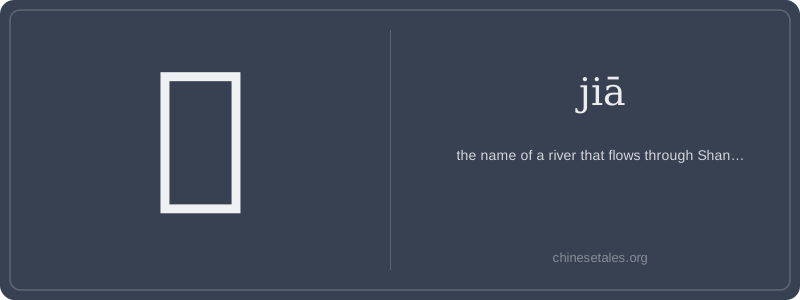
The character 泇 first appeared in late Zhou bronze inscriptions and early Han bamboo slips — not as a pictograph, but as a phonosemantic compound. Its left radical 氵 (water) signals aquatic association, while its right side 嘉 (jiā) serves purely as a phonetic loan: 嘉 was borrowed for its sound, not its meaning (‘excellence, auspiciousness’). There’s no ancient pictorial origin — no flowing water glyph or winding river shape. Instead, 泇 emerged from scribal convenience: scribes needed a distinct, unambiguous way to transcribe the river’s local pronunciation, so they fused water + jiā.
Over centuries, 泇 remained narrowly tied to the Si River system — appearing in Tang dynasty geographical records like the Yuanhe Junxian Tu Zhi and Ming-era local gazetteers. Crucially, it never generalized: unlike 河 (hé) or 江 (jiāng), 泇 never spawned verbs, adjectives, or idioms. Its visual stability — three water dots plus 嘉 — mirrors its semantic rigidity: a perfect case of form following function without flourish. Even today, seeing 泇 feels like glimpsing a sealed envelope marked ‘For Historical Use Only’.
泗泇 (Sì Jī) isn’t just a river name — it’s a quiet testament to how deeply geography is etched into Chinese writing. 泇 appears almost exclusively as part of the hydronym 泗泇河 (Sì Jī Hé), an archaic or literary variant for the Si River, historically vital in Shandong and Jiangsu. Unlike common nouns, 泇 carries zero independent semantic weight: you’ll never see it meaning ‘river’ generically, nor used metaphorically. It’s a proper noun fossil — frozen in place like a geological stratum. To native speakers, it evokes regional history, not hydrology.
Grammatically, 泇 functions only as a rigid component in fixed toponyms. You won’t conjugate it, modify it with adjectives, or pluralize it — it doesn’t behave like a word at all. Learners sometimes mistakenly treat it like 泾 (jīng, another river name) or try to parse it as ‘water + something’, but 泇 has no productive morphemic role. Its sole job is to anchor a specific stretch of water on historical maps — and even then, modern usage favors 泗水 (Sì Shuǐ) over 泗泇.
Culturally, 泇 reveals how Chinese handles linguistic preservation: characters survive not because they’re useful, but because they’re embedded in classical texts or local identity. Mistaking it for a general ‘river’ character leads to unnatural phrasing — e.g., saying *‘this 泇 is wide’* sounds like quoting a 12th-century gazetteer. Native speakers rarely encounter 泇 outside academic or archival contexts, making it a gentle reminder that not every character in the dictionary breathes in daily speech.