戤
Character Story & Explanation
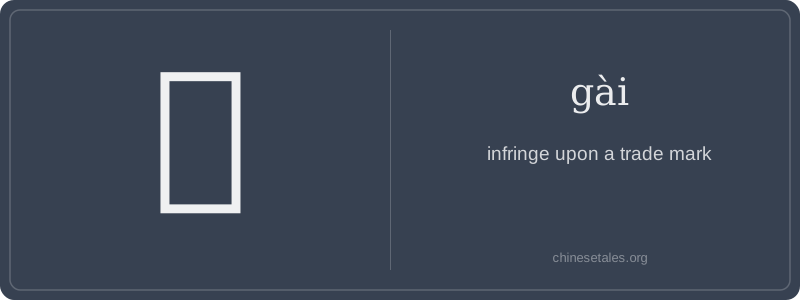
The character 戤 first appeared in late Warring States bamboo texts, not oracle bones — and its form tells a story of boundary violation. The left side 戈 (gē, 'dagger-axe') wasn’t chosen for combat, but for its visual function as a 'boundary marker' — ancient bronze inscriptions used 戈-like strokes to demarcate territorial or ritual limits. The right side 肐 (gè) is a phonetic component derived from 隔 (gé, 'to separate'), but stylized into three stacked horizontal strokes (一 一 一) representing layers of separation being crossed. Over centuries, the top stroke of 肐 merged with the 戈’s diagonal, and the lower strokes condensed — yielding today’s compact, angular 13-stroke form.
Its meaning crystallized during the Ming-Qing commercial boom, when guilds fiercely protected brand marks on silk, porcelain, and ink sticks. Early legal codes used 戤 specifically for unauthorized use of another merchant’s registered 'shop mark' (铺记), treating it as a breach of trust, not just law. Unlike generic terms like 冒用 (màoyòng, 'to impersonate'), 戤 implied intent and visibility — the infringer didn’t hide; they boldly overlaid their own name atop another’s established symbol. This semantic precision endured: even modern PRC Trademark Law (Article 57) retains 戤 as the sole character for 'trademark infringement' in formal legislative drafting — a rare case of a pre-modern character surviving unchanged in contemporary statute.
At first glance, 戤 (gài) feels like a linguistic relic — a sharply edged, rarely used character that appears almost exclusively in legal or bureaucratic contexts to mean 'to infringe upon a trademark.' It carries none of the warmth or flexibility of everyday verbs; instead, it’s precise, accusatory, and slightly archaic — like pulling out a wax seal to stamp a violation. Native speakers don’t say 戤 casually; they deploy it deliberately, often in formal warnings or official notices, where tone matters as much as semantics.
Grammatically, 戤 is a transitive verb requiring a clear object: you 戤 *a specific trademark*, never just 'infringe' abstractly. It rarely appears in progressive or perfect aspect — no 戤着 or 已戤; instead, it’s usually in simple past or future constructions (e.g., 该公司戤了我们的商标). Learners often mistakenly treat it like a synonym for 侵犯 (qīnfàn), but 戤 is narrower, more technical, and legally freighted — using it outside trademark law sounds oddly anachronistic, like citing Magna Carta in a coffee shop dispute.
Culturally, 戤 reveals how Chinese legal language preserves classical economy: one character, one precise offense. Its rarity makes it a 'signal word' — when it appears in a document, readers instantly recognize this isn’t routine copying, but a formal, registrable violation. A common learner trap? Pronouncing it as gē or gǎi — but its tone is fourth (gài), echoing the sharp, decisive 'cut' of infringement. Also, many confuse it with 戈 (gē, 'dagger-axe') due to the shared radical — but 戬 has zero martial connotation; its violence is purely intellectual property warfare.