擖
Character Story & Explanation
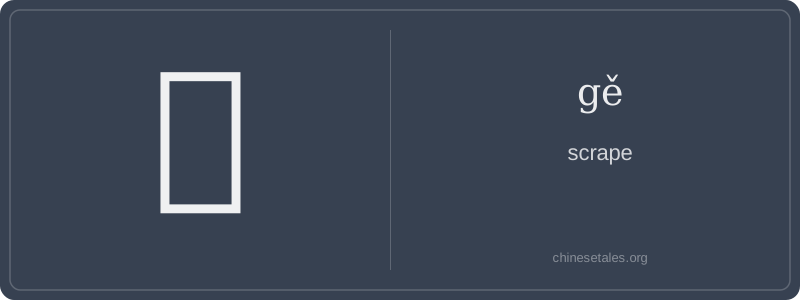
The earliest form of 擖 appears in late Warring States bamboo texts — not oracle bones — as a composite glyph: the left side was 扌 (hand radical), and the right was 戊 (wù), an ancient weapon/axe symbol resembling a halberd. Over centuries, 戊 morphed into the modern 古 (gǔ) shape through clerical script simplification — not because of meaning, but due to cursive handwriting habits. So visually, 擖 looks like ‘hand + ancient’, but etymologically, it’s ‘hand + axe’ — a hand wielding a scraping tool.
This evolution reflects its semantic journey: from literal physical scraping (e.g., erasing inscriptions on bamboo strips in the *Zuo Zhuan*) to metaphorical ‘erasure’ — like scraping away falsehoods or pretense. In Ming dynasty novels, 擖 occasionally appears in artisan contexts: ‘擖木’ (scraping timber to smooth grain). Its visual link to 古 (ancient) is pure coincidence — yet ironically fitting: this character itself feels like an artifact scraped clean from linguistic history.
Let’s be honest: 擖 (gě) is a rare, almost ghostly character — it’s like finding a forgotten vinyl record in your grandparents’ attic. Its core meaning is 'to scrape' or 'to rub off forcefully', but not the gentle kind — think chiseling rust off iron, scraping dried glue from wood, or even (in classical usage) scraping ink off bamboo slips to erase a mistake. It carries a gritty, tactile, slightly abrasive energy — you can almost hear the scratch.
Grammatically, 擖 is almost always a verb, and it’s highly transitive: you *must* say what you’re scraping *off of* something — so it often appears with the particle ‘下’ (xià) or prepositional phrases like ‘从…上’ (cóng…shàng). You won’t see it in daily conversation — it’s mostly literary, technical, or historical. Learners sometimes mistakenly use it where 刮 (guā) or 擦 (cā) would fit; but 擖 implies effort, resistance, and removal — not just surface contact.
Culturally, this character whispers of ancient scribes erasing bamboo manuscripts before reuse — a physical act of revision with moral weight. Modern learners rarely encounter it, but spotting 擖 in a classical text signals you’re reading something precise, deliberate, and materially aware. The biggest trap? Assuming it’s interchangeable with other ‘scraping’ verbs — it’s not. It’s the chisel, not the sponge.