擗
Character Story & Explanation
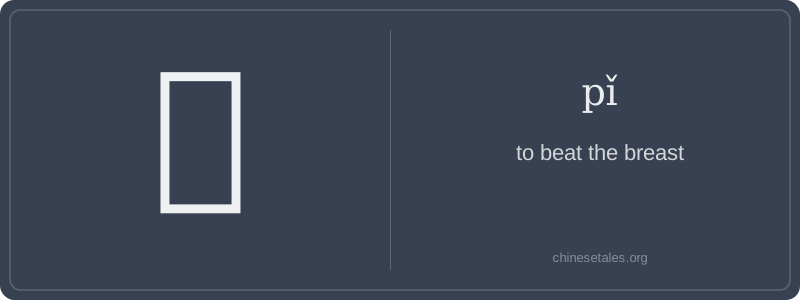
The earliest form of 擗 appears in Warring States bamboo texts as a hand radical () beside a phonetic component resembling ‘辟’ (bì/pì) — not yet fully standardized. Its bronze script ancestor depicted a raised arm striking downward toward a simplified torso glyph. Over centuries, the right side solidified into 辟 (originally meaning ‘to open up’ or ‘to ward off’), while the left retained 扌 — emphasizing the *intentional, controlled motion* of the hand, not random hitting. By the Han dynasty clerical script, the 16 strokes were fixed: three horizontal strokes for the hand’s base, then the complex 辟 with its ‘opening’ (辛) and ‘spreading’ (廾) implications — subtly reinforcing how beating the chest *opens* or *releases* pent-up emotion.
This semantic link to ‘opening’ is key: in classical usage, 擗 wasn’t just about pain — it was a ritual act of *unsealing the heart* before heaven or ancestors. Mencius mentions mourners 擗踊 (pǐ yǒng — ‘beat chest and leap’) to show sincerity beyond words. Later, in Tang poetry and Ming drama, 擗 evolved into shorthand for *visceral, unrestrained reaction* — whether grief, rage, or even comedic despair. Its visual weight — 16 strokes, angular and urgent — mirrors the physical effort of the gesture itself.
Think of 擗 (pǐ) as Chinese opera’s version of Shakespearean grief — that dramatic, chest-thumping gesture you see in tragedies when a character wails ‘O woe is me!’ It doesn’t mean ‘to hit’ or ‘to slap’ in a general sense; it’s hyper-specific: to strike one’s own chest with the palm, usually in overwhelming sorrow, shock, or protest. This isn’t casual — it’s performative mourning, rooted in ancient ritual and still evoked in literary or highly stylized speech.
Grammatically, 擗 is almost always transitive and appears in compound verbs like 擗胸顿足 (pǐ xiōng dùn zú — ‘beat chest and stamp feet’), rarely standing alone. You won’t hear it in daily chat — no one says ‘I’ll 擗 my chest now’ — but you’ll spot it in classical allusions, obituaries, or satirical writing mocking excessive lamentation. Learners often misread it as pī (like in 劈) or confuse its radical — it’s 扌 (hand), not 刂 (knife) or 忄 (heart) — so they wrongly assume emotional or cutting meanings.
Culturally, this gesture echoes Confucian ideals of visible, embodied sincerity: grief must be *performed* to be believed. Yet today, using 擗 unironically can sound archaic or theatrical — like quoting Hamlet at a Zoom meeting. The real trap? Assuming it’s interchangeable with 哭 (kū, ‘to cry’) — but crying is quiet; 擗 is loud, physical, and deeply ceremonial.