擞
Character Story & Explanation
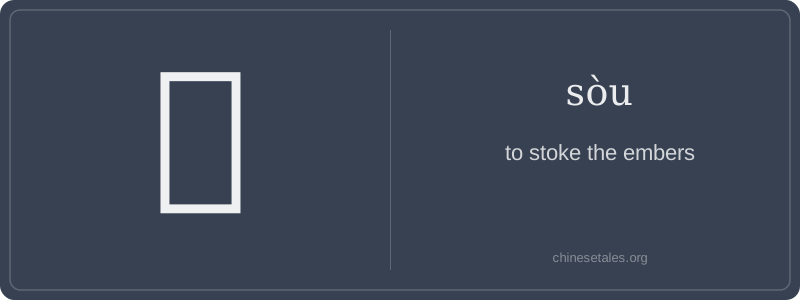
The earliest form of 擞 isn’t found in oracle bones, but emerges clearly in late Warring States bamboo texts and Han dynasty seals: it began as 扌 (hand radical) + 散 (sàn, ‘to scatter’), not as a pictograph but as a semantic-phonetic compound. The right side 散 originally depicted hand-dropping grains — but here it serves *phonetically* (both 散 and 擞 share the -òu/-àn rhyme evolution in Middle Chinese), while 扌 anchors the meaning: ‘hand action.’ Over centuries, the top of 散 simplified — the ‘moon’ component (⺼) merged into a horizontal stroke, and the ‘ten’ (十) became a compact dot-and-stroke cluster, yielding today’s elegant 16-stroke form with its distinctive double ‘X’-like lower right.
This visual structure — hand + controlled dispersal — perfectly mirrors the action: not random stirring, but precise, repeated prodding to scatter ash and expose glowing embers beneath. In the 14th-century classic Water Margin, a monk is described as ‘擻炭火,续茶烟’ (sǒu tàn huǒ, xù chá yān) — stoking charcoal to reignite the tea kettle’s steam — showing how 擞 bridges practical warmth and ceremonial calm. Even today, the character’s shape evokes rhythmic motion: the three dots on the left (扌) suggest fingers moving, the angular right side mimics the poke-and-sweep of a fire iron.
At its heart, 擞 (sòu) is a vivid, kinetic verb — not just 'to stoke,' but to *rekindle with purpose*: poking embers to coax warmth and light back from near-extinction. It’s tactile, intentional, and slightly urgent — you don’t ‘sòu’ a roaring fire; you sòu when the coals are fading and you’re determined to revive them. Think of it as the linguistic equivalent of blowing gently on a candlewick before striking the match again.
Grammatically, 擞 is almost always transitive and action-oriented, requiring a direct object: 擞火 (sòu huǒ), 擞炉子 (sòu lú zi). It rarely appears in isolation or in abstract contexts — you won’t hear ‘sòu hope’ or ‘sòu memories’ (those would use other verbs like 点燃 or 唤起). A common learner mistake is overgeneralizing it like English ‘stoke,’ leading to unnatural phrases like *‘sòu enthusiasm’ — which sounds like you’re jabbing excitement with a poker! Instead, it stays firmly grounded in physical, thermal agency.
Culturally, 擞 carries quiet resonance with traditional hearth-centered life: the family stove wasn’t just heat — it was continuity, safety, ritual. In classical poetry and Ming-Qing vernacular fiction, 擞 often appears in winter scenes or moments of quiet perseverance — e.g., an old man alone in his study, 擞着炭盆, tending the last warmth while composing verse. Modern usage is rare outside literary or nostalgic registers, making it a subtle marker of stylistic intention — like choosing ‘quench’ over ‘put out’ in English.