攫
Character Story & Explanation
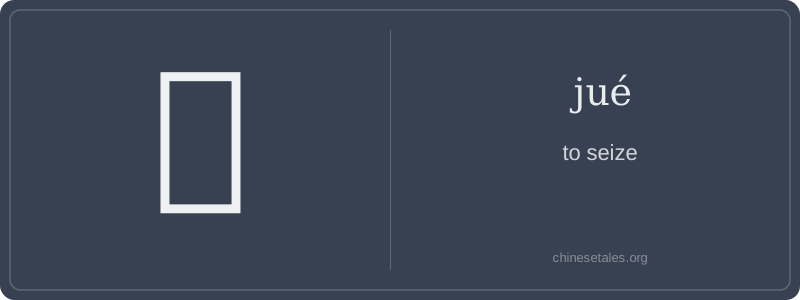
The earliest form of 攫 appears in Warring States bamboo slips as a complex pictograph: on the left, a hand radical (扌), and on the right, a fierce bird-like creature with outstretched talons — likely inspired by the ancient mythic raptor ‘jué’ (a type of falcon or eagle). Over centuries, the avian element evolved: the top became 爪 (zhuǎ, 'claw'), the middle transformed into 俊 (jùn, 'talented', but here phonetic), and the bottom stabilized as 女 (nǚ, 'woman') — though this ‘woman’ is purely structural, not semantic. By the Han dynasty, the character had crystallized into its modern 23-stroke form, preserving the claw-and-hand synergy that screams ‘violent grasp’.
This visual logic shaped its meaning across millennia. In the Chu Ci (Songs of Chu), 攫 describes spirits snatching souls; in Tang poetry, it evokes eagles seizing prey mid-air. Even today, its shape — with 扌 (hand) gripping the claw-like 爪 atop 俊 and 女 — feels like a hand clenching around something sharp and alive. That tension between human agency (hand) and predatory instinct (claw) is why 攫 never softened into generic ‘take’ — it’s etymologically wired for drama, danger, and decisive action.
At its core, 攫 (jué) isn’t just ‘to seize’ — it’s to snatch *violently*, *instinctively*, and often *with claws or fingers*. Think of a hawk diving, a tiger lunging, or a panicked person grabbing the last seat on the subway. The character pulses with urgency and physicality; it implies force, immediacy, and sometimes even greed or desperation — never polite acquisition. You’ll rarely see it in daily conversation (hence its absence from HSK), but it thrives in literary, journalistic, and rhetorical contexts where vivid imagery matters.
Grammatically, 攫 is almost always a transitive verb, requiring a direct object — you 攫 something: 攫住 (jué zhù, 'seize and hold fast'), 攫取 (jué qǔ, 'snatch up/claim forcefully'). It can also appear in reduplicated form 攫攫 (jué jué) for poetic emphasis, or as part of compound verbs like 攫获 (jué huò, 'to seize and gain' → 'to win decisively'). Crucially, it’s not used for abstract or gentle taking — don’t say *I 攫 an idea*; use 想到 or 获得 instead. Learners often overuse it, mistaking intensity for correctness.
Culturally, 攫 carries a faint moral shadow — classical texts like the Zhuangzi use it to criticize obsessive grasping at fame or wealth. Modern media deploys it for dramatic effect: headlines scream ‘资本攫取利润’ ('capital snatches profits') to imply exploitation. A common pitfall? Confusing it with 抓 (zhuā, 'grab') — which is neutral and colloquial — or 夺 (duó, 'seize by force') — which emphasizes contest or usurpation, not bodily action. 攫 is visceral, animalistic, and unapologetically hands-on.