敃
Character Story & Explanation
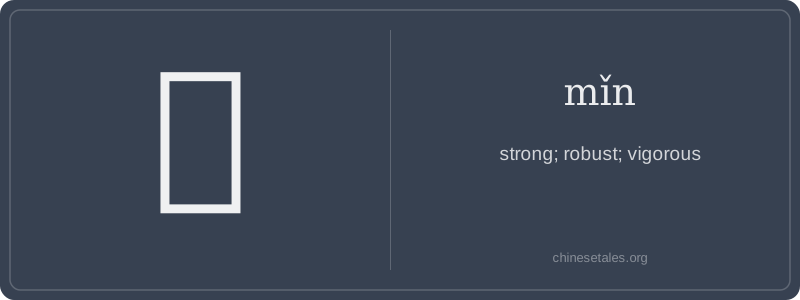
Carve this into your mind: the earliest form of 敃 (found on Warring States bamboo slips) shows two key elements — a simplified ‘mǐn’-sounding phonetic component (min, later evolving into 丿 + 一 + 丶 + 一) atop the radical 攵 (pū, ‘to strike, act’). But here’s the twist: that top part isn’t just sound — it’s a stylized ‘arrowhead’ (矢) fused with a ‘heart’ (心) shape in early scripts, symbolizing focused, directed inner power. Over centuries, the arrowhead flattened, the heart compressed, and the ‘striking’ radical 攵 at the bottom anchored the idea of *applied* vigor — not passive toughness, but strength in action.
This visual logic became semantic truth: by the Han dynasty, 敃 appears in texts like the *Shuōwén Jiězì* defined as ‘strong and firm’ (強也), specifically describing moral fortitude and physical resilience in tandem. In Tang poetry, it’s used for stalwart generals whose resolve is ‘敃如金石’ (as solid as metal and stone). The character never meant brute force — its 攵 radical insists it’s *exercised* strength: disciplined, purposeful, and enduring. That fusion of inner focus (top) and outward action (bottom) remains its silent grammar.
Let’s crack 敃 (mǐn) like a linguistic nut. First, its vibe: it’s not your everyday ‘strong’ — it’s the kind of robustness you’d describe in classical poetry or martial arts manuals: thick-boned, unshakable, deeply rooted strength, almost physical in its density. Think less 'I’m strong' and more 'his spirit is 敃 — unyielding, resilient, forged'. It’s archaic and literary; you won’t hear it in casual chats or HSK textbooks — it lives in essays, historical novels, and formal eulogies.
Grammatically, 敃 is strictly an adjective — never a verb or noun — and it almost always modifies nouns directly (no ‘de’ needed). You’ll see it in patterns like ‘敃健’ (mǐn jiàn), ‘敃毅’ (mǐn yì), or standalone in parallel phrases: ‘体魄敃,意志坚’ (Strong physique, firm will). Crucially, it *never* takes aspect particles like ‘le’ or ‘guo’, nor does it combine with degree adverbs like ‘hěn’ — saying ‘hěn 敃’ sounds like saying ‘very thunderous’ in English: poetic, but wrong. Its strength is absolute, not gradable.
Culturally, 敃 carries quiet gravitas — it’s the strength of endurance, not explosion. Learners often misread it as ‘mǐn’ meaning ‘quick’ (like 敏) or confuse it with 愍 (mǐn, ‘to pity’) due to identical pronunciation and similar stroke count. But 敃 has zero emotional softness — it’s stoic, structural, bone-deep. Its rarity means even many native speakers pause before using it; when they do, it signals deliberate, elevated diction — like choosing ‘valiant’ over ‘brave’ in English.