敜
Character Story & Explanation
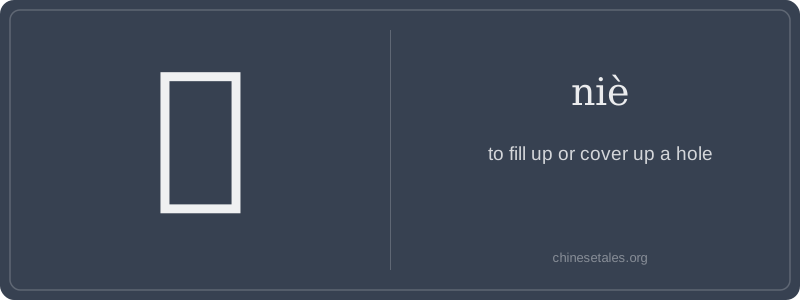
The earliest form of 敜 appears in bronze inscriptions as a vivid compound: on the left, a simplified ‘earth’ or ‘soil’ component (the precursor to 土), and on the right, a hand holding a tool — not a shovel, but a small, flat trowel or tamp used for smoothing and sealing. Over centuries, the hand morphed into the modern 又 (yòu, ‘again’), while the soil became 土, and the trowel fused into the lower right stroke cluster — giving us today’s 敜, where every line feels like a downward press, a firm cover. Its oracle bone roots are lost, but the bronze-era clarity remains: this was never about digging *in*, but pressing *down*.
This tactile origin shaped its meaning across dynasties. In the Zuo Zhuan, 敜 appears when describing how officials ‘sealed the cracks in the ancestral temple walls before the rites’ — not for repair, but to prevent spiritual leakage. By the Han, it shifted subtly toward metaphorical use: ‘敜其口’ (seal their mouth) meant silencing dissent with finality. The character’s visual weight — that heavy, grounded lower half — mirrors its semantic gravity: once something is 敜’d, it’s considered *closed off*, not merely occupied. No classical text uses it lightly; it’s the linguistic equivalent of locking a chest with a single, decisive turn of the key.
Forget everything you know about 'filling holes' — 敜 isn’t about buckets of dirt or duct tape. It’s a rare, almost poetic verb that evokes the deliberate, quiet act of *sealing* something away: a crack in a wall, a gap in logic, even an emotional wound. Its core feeling is one of careful concealment, not brute force — think of tamping down ashes after a fire, not shoveling gravel into a crater. Linguistically, it’s strictly transitive and almost always appears in classical or literary contexts; you’ll never hear it in daily chat (hence its absence from HSK). It often pairs with objects like 缝 (fèng, seam), 穴 (xué, cavity), or 隙 (xì, crevice), and frequently takes the structure ‘以…敜…’ (‘using X to fill/seal Y’).
Grammatically, 敜 behaves like a monosyllabic verb but demands precision: it implies *complete coverage*, not partial filling. Saying ‘敜住洞’ (niè zhù dòng) means ‘plug the hole *so nothing leaks through*’, whereas 填 (tián) just means ‘fill up’. Learners sometimes misread it as 埼 (qí, embankment) or 堙 (yīn, to dam), but those imply large-scale engineering — 敜 is intimate, surgical, even secretive. It’s the verb you’d use in a Tang dynasty poem describing sealing a letter with wax, not building the Great Wall.
Culturally, 敜 carries faint Daoist resonance: it’s about restoring wholeness by eliminating disruptive openings — a microcosm of harmony. Mistake alert: don’t confuse its sound niè with niè (涅, to dye black) or niè (孽, evil deed); the meanings share no root. Also, despite its ‘earth’ radical, it’s not about soil — it’s about *intentional closure*. You won’t find it on menus or subway signs, but if you stumble upon it in a Song essay or a Ming drama script, pause: you’ve just touched linguistic velvet.