敿
Character Story & Explanation
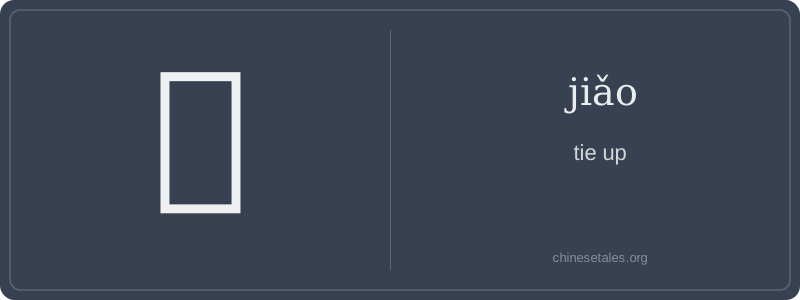
The earliest form of 敿 appears in bronze inscriptions (c. 1000 BCE) as a vivid pictograph: two parallel vertical lines representing rope, crossed by a bold horizontal stroke — like ropes being pulled taut and secured over a post or beam. Over centuries, the ‘rope’ lines evolved into the left-side radical 糸 (sī, silk/thread), while the ‘securing bar’ transformed into the right-side component 交 (jiāo, 'to cross'), which itself originally depicted crossed legs — suggesting entanglement and mutual constraint. By the seal script era, the character had crystallized into its current structure: 糸 + 交 — literally 'thread crossing,' evoking the moment tension is applied to hold something fast.
This visual logic shaped its semantic evolution: from literal binding (Zhou dynasty ritual texts describe 敿 sacrificial animals) to metaphorical containment (Han dynasty poets wrote 敿愁, 'tying up sorrow' — i.e., suppressing emotion). In the Book of Rites, 敿 appears in instructions for preparing chariots: '敿革而驾' ('tie the leather straps and harness'). Even today, calligraphers note that the balanced yet slightly asymmetrical stroke order — especially the decisive downward hook in 交 — mirrors the physical act of pulling rope tight: controlled force, not gentle looping.
Let’s be honest: you won’t find 敿 on modern menus, subway signs, or HSK flashcards — and that’s precisely what makes it fascinating. This character means 'to tie up' in a very concrete, almost visceral sense: think binding ropes around bundles, securing livestock, or lashing gear before a journey. It carries the physical weight of constraint and preparation — not abstract 'tying' like in relationships (that’s 系 or 绑), but deliberate, functional fastening. In classical usage, it often appeared in agricultural or military contexts, where precision in binding affected survival.
Grammatically, 敿 is almost exclusively a verb and rarely appears alone today; it prefers compound forms like 敿住 or 敿牢. Learners sometimes try to use it like 系 (xì) — e.g., *敿鞋带 — but that’s ungrammatical and instantly marks you as consulting an ancient dictionary instead of WeChat. Native speakers now use it mostly in literary, poetic, or regional dialect-influenced speech (e.g., certain Wu or Min varieties), or in set phrases preserved in idioms or historical novels.
Culturally, 敿 reflects an older Chinese worldview where material security — how well you secured your harvest, your boat, your horse — was inseparable from moral diligence. Confucius didn’t say ‘tie your shoelaces’ — but Mencius did praise farmers who ‘敿耒耜’ (tied their ploughs securely) before winter. A common mistake? Assuming it’s interchangeable with 結 (jié, 'to knot') — but 敿 implies tension, restraint, and purposeful immobilization, while 結 suggests connection or completion. It’s less ‘knotting’ and more ‘locking down.’