斁
Character Story & Explanation
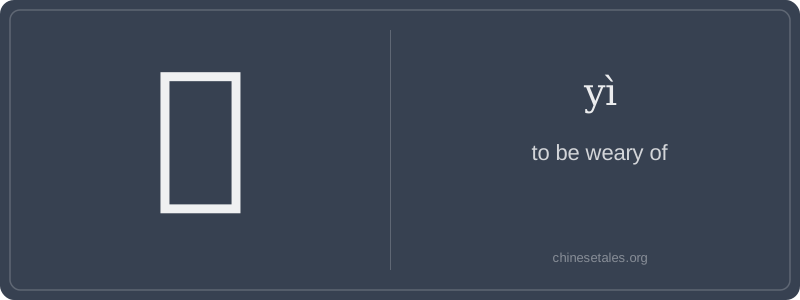
The earliest form of 斁 appears in bronze inscriptions (c. 1000 BCE) as a compound pictograph: on the left, a simplified ‘sacrificial altar’ (the precursor to the radical ⺈, later evolving into the top part resembling 广), and on the right, a kneeling figure (the ancestor of the bottom component, which resembles 也 but originally depicted a person bowing deeply, exhausted). Over centuries, the altar morphed into 广 (a roof-like cover symbolizing ritual space), while the kneeling figure stylized into + 也 — losing its literal posture but keeping the sense of bowed submission under weight. By the Han dynasty, it had settled into today’s structure: 广 (roof/ritual space) over + 也 (exhausted compliance).
This visual evolution mirrors its semantic journey: from depicting physical collapse before an altar (ritual fatigue) to abstract moral endurance. In the Shijing (Book of Songs), 斁 appears in Ode 242: ‘靡不有初,鲜克有终;... 不斁于礼’ — praising those who maintain ritual devotion without tiring. The character itself became a benchmark of virtue: if even the sages *could* 斁, their refusal to do so made them extraordinary. Its rarity today reflects how profoundly Confucian ideals elevated sustained effort — making 斁 less a word than a moral milestone.
Let’s be honest: 斁 (yì) is a rare, elegant ghost of classical Chinese — not something you’ll hear in street conversations, but one that haunts poetry, philosophy, and refined prose like a whisper of exhaustion. Its core meaning isn’t just ‘to be tired’ (that’s 累 or 困), but a deeper, almost philosophical weariness — the soul-sigh after enduring something *too long*: a duty, a ritual, a moral ideal pushed to its breaking point. Think of Confucius sighing over decades of failed state advising — that’s 斁.
Grammatically, it’s almost always used in formal, literary constructions — never alone as a verb in modern speech. You’ll find it in classical patterns like ‘弗敢斁’ (fú gǎn yì, ‘dare not grow weary’) or ‘终日不斁’ (zhōng rì bù yì, ‘not weary all day’). It’s nearly always paired with negation (不, 弗, 未) or modality (敢, 忍), and almost never takes an object directly — instead, it implies weariness *toward* something previously established in context (e.g., ‘礼’ or ‘道’). Learners mistakenly treat it like 烦 or 厌 — but 斁 carries no annoyance or dislike; it’s pure, dignified fatigue of persistence.
Culturally, 斁 appears most often in texts celebrating unwavering virtue — precisely *because* it names the very temptation to quit. In the Book of Songs, it praises rulers who ‘不斁于礼’ (bù yì yú lǐ): ‘do not grow weary of ritual propriety.’ That tiny character holds immense moral weight: to 斁 is human; to *not* 斁 is sage-like endurance. Mistake it for 厌 (yàn, ‘to dislike’), and you’ve turned reverence into resentment — a classic ‘tone + meaning’ trap!