斞
Character Story & Explanation
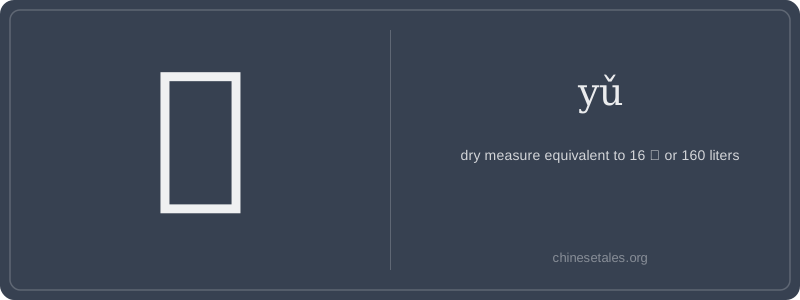
The earliest form of 斞 appears on Warring States bamboo slips and Han dynasty seals — not as a pictograph, but as a carefully constructed ideograph. Its left side, ⺈ (a variant of 亠, representing ‘cover’ or ‘lid’), merges with the right side, 卣 (yǒu), an ancient bronze wine vessel shaped like a covered pot with a handle — a symbol of ritual containment and measured capacity. Over centuries, 卣 simplified into the modern 古 + 皿 structure beneath the lid, while the top evolved from a clear ‘roof’ shape into the current 亠 + 丨 + 丶 configuration. Every stroke was intentional: containment (top), vessel (right), and measurement (implied by the vessel’s standardized volume).
This visual logic reflects its meaning perfectly: a sealed, official container calibrated to hold precisely one 斞. In the Rites of Zhou, 斞 appears alongside other standardized units like 斛 (hú) and 斗 (dǒu) in chapters governing granary management. By the Tang dynasty, it had largely been replaced by 斛 in daily use, but remained in legal statutes — a testament to how writing preserves administrative precision long after spoken language moves on. Its shape is literally a bureaucratic seal stamped onto semantics.
Let’s be real: 斞 (yǔ) isn’t something you’ll need to order dumplings or book a train ticket — it’s a fossil of pre-modern Chinese metrology, preserved like amber in classical texts and historical documents. It represents a *very* specific dry measure: exactly 16 斗 (dǒu), or roughly 160 liters — enough grain to feed a small village for a week in the Han dynasty. The character feels archaic and weighty, not functional; native speakers today almost never use it in speech, and even most historians only encounter it when reading land registers, tax codes, or agricultural treatises like the Qí Mín Yào Shù.
Grammatically, 斞 functions strictly as a noun — always a unit noun, never a verb or adjective. You’ll see it after numerals (e.g., 一斞, 三斞) or in compound nouns like 斞斗 (yǔ dǒu), but never standalone as a subject or object without quantification. A classic mistake? Learners sometimes misread it as a verb due to its ‘-u’ rhyme (like 去 qù), or confuse it with 吕 (lǚ) or 宇 (yǔ) — both homophones but utterly unrelated in meaning or function.
Culturally, 斞 is a quiet witness to imperial standardization. In the Qin and Han dynasties, uniform measures were political tools — enforcing fairness in taxation and trade across vast territories. Using 斞 correctly signals deep literacy in historical Chinese, not conversational fluency. Think of it less like ‘cup’ or ‘gallon’ and more like ‘bushel’ in English: technically precise, historically loaded, and increasingly poetic.