斢
Character Story & Explanation
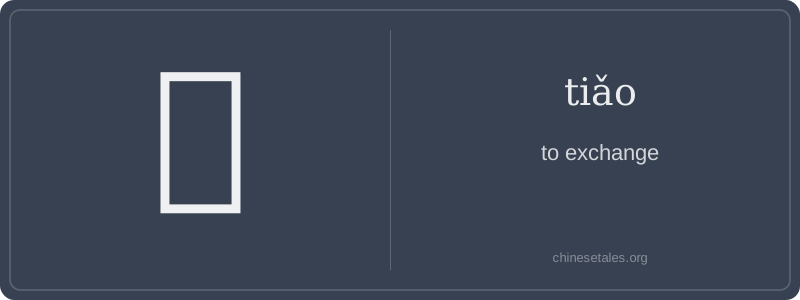
The earliest form of 斢 appears in bronze inscriptions of the Western Zhou dynasty (c. 1046–771 BCE) as a compound pictograph: two hands () flanking a stylized container (perhaps a grain measure or ceremonial vessel), with a small stroke indicating movement between them. Over centuries, the left hand simplified into the radical 扌 (hand radical), the right hand fused with the vessel into the phonetic component 丿一彐 (a distorted, cursive rendering of the ancient 'exchange' sign), and the central motion stroke hardened into the vertical line. By the Han dynasty clerical script, it had stabilized into its modern structure — visually echoing two parties leaning in, handing something across a threshold.
This visual reciprocity shaped its semantic journey: in the Shuōwén Jiězì (121 CE), Xu Shen defined it as 'mutual giving — one gives, the other receives, without surplus or deficit'. It appears in Tang dynasty poetry describing silk-for-horse trades along the Silk Road, and in Ming legal codes governing land swaps among clans. Even today, calligraphers sometimes use 斢 in seals to signify 'balanced exchange of respect' — a silent nod to its enduring symbolic weight as harmony made visible.
At first glance, 斢 (tiǎo) feels like a linguistic ghost — it’s real, it’s in dictionaries, and it means 'to exchange', yet you’ll almost never hear it spoken in modern Mandarin conversation. Unlike common exchange verbs like 换 (huàn) or 交换 (jiāohuàn), 斢 carries an archaic, almost ritual weight: it evokes barter in pre-monetary markets, the solemn swapping of betrothal gifts, or the careful mutual adjustment of obligations — not just objects, but balance itself. Its meaning isn’t transactional; it’s relational and reciprocal by definition.
Grammatically, 斢 is almost exclusively used as a verb in literary or formal written contexts — rarely as a standalone word, and never in casual speech. You’ll find it embedded in classical-style compounds like 斢换 (tiǎo huàn) or 斢易 (tiǎo yì), often in historical novels, legal documents from late imperial China, or poetic prose. Crucially, it cannot take aspect markers like 了 or 过 (*斢了, *斢过 are ungrammatical), nor does it combine freely with objects — it demands symmetry: ‘A 斢 B’ implies A gives X and receives Y, while B gives Y and receives X. Learners mistakenly try to substitute it for 换 in everyday sentences — resulting in jarringly antique, even comical phrasing.
Culturally, 斢 reveals how deeply Chinese conceptualizes exchange as a calibrated, face-to-face act — not abstract transfer, but embodied reciprocity. Its near-erasure from spoken language signals a shift from intimate, obligation-bound barter to impersonal, market-mediated trade. And yes — it *can* be pronounced tǒu in rare regional dialectal texts or ancient rhyme dictionaries, but that reading is functionally extinct outside scholarly footnotes.