斧
Character Story & Explanation
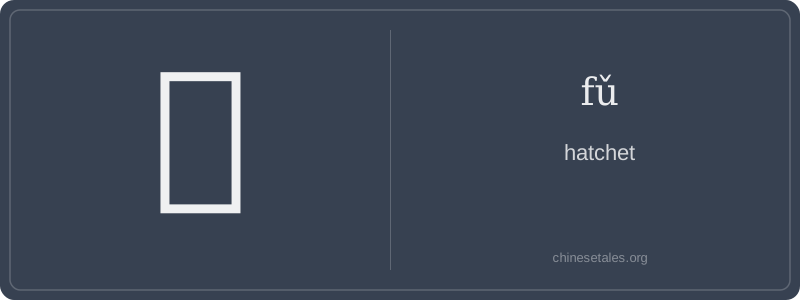
The earliest form of 斧 appears on Shang oracle bones as a clear pictograph: a vertical line representing the handle, topped by a bold, asymmetrical curved blade — like a sideways 'C' with a sharp lower hook. In bronze script, the blade sharpened into a distinct angular shape, and by the Small Seal Script (Qin dynasty), the top became the stylized component 甫 (fǔ), while the bottom retained the axe radical 斤 — merging phonetic and semantic elements. Stroke by stroke, it crystallized into today’s eight-stroke form: the left side 甫 (a phonetic hint) + the right-side 斤 (the semantic 'axe' radical), visually echoing how ancient smiths forged the tool — blade welded onto haft.
This character didn’t just name a tool — it embodied action. In the *Book of Documents*, rulers ‘wielded the axe’ to enforce law; in Tang poetry, Li Bai wrote of ‘swinging the axe at the moon’s reflection’, turning metal into myth. The visual logic is brilliant: 斤 (the radical) is itself a simplified axe — so 斧 doubles down on that idea, adding 甫 as both sound clue and a hint of ‘foundation’ (since 甫 originally meant ‘beginning’ or ‘foundation’ — as in laying the first log). Thus, 斧 isn’t just ‘hatchet’ — it’s *the foundational act of cutting*.
Imagine holding a bronze hatchet in your hand — sharp, heavy, decisive. That’s the visceral feel of 斧 (fǔ): not just any axe, but a compact, one-handed tool for chopping wood, splitting logs, or (in ancient times) executing justice. Its core meaning is tightly bound to *forceful, precise severing* — whether literal or metaphorical. Unlike broader terms like 斧头 (fǔtóu, 'hatchet') or more generic 刀 (dāo, 'knife'), 斧 carries an old-world weight: it’s the tool of carpenters, executioners, and poets who wield words like blades.
Grammatically, 斧 is almost never used alone in modern spoken Mandarin — you’ll rarely hear someone say 'I need a fǔ'. Instead, it appears in literary compounds (e.g., 斧正 fǔzhèng, 'please correct my writing' — literally 'hatchet-correct', implying humble, incisive revision), idioms (e.g., 班门弄斧 bānmén nòng fǔ, 'to display one’s axe before Lu Ban', i.e., show off before an expert), or classical allusions. Learners often mistakenly treat it as a standalone noun like 'axe' in English — but without context or compound support, it sounds archaic or poetic, not conversational.
Culturally, 斧 evokes both craftsmanship and authority: in Zhou dynasty bronze inscriptions, it symbolized judicial power; in Daoist texts, it appears as a metaphor for cutting through illusion. A common mistake? Confusing it with 斧头 (fǔtóu) — where 斧 alone is literary, while 斧头 is colloquial. Also, note its radical 斤 (jīn) — the 'axe' radical itself — which appears in related characters like 新 (xīn, 'new', originally 'chopping wood to make fresh kindling') and 斯 (sī, 'this', from 'cutting apart').