斾
Character Story & Explanation
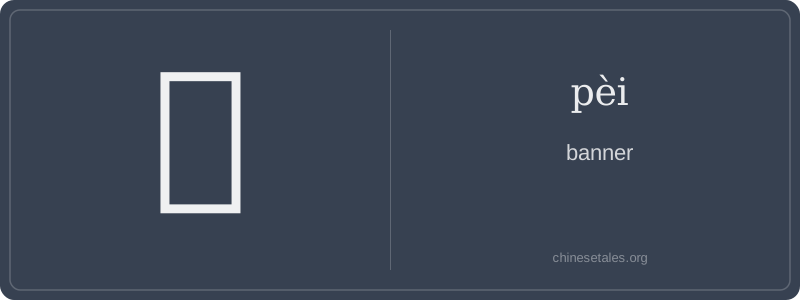
The earliest trace of 斾 appears not in oracle bones, but in Warring States bronze inscriptions and early seal script — where it’s clearly a variant of 旆. Visually, it merges two key elements: the left side (方) representing the banner’s rectangular frame or mounting pole, and the right side (巿), a stylized depiction of fluttering fabric with tassels and streamers. Over centuries, clerical script simplified the fringes into the three horizontal strokes beneath 巿, while the pole (方) retained its angular stability — creating a balanced, upright composition that literally ‘stands tall’ like a banner on a staff.
This character’s evolution mirrors China’s ritual statecraft: from Shang divination banners marking sacred space, to Zhou dynasty rites where 斾/旆 signaled noble rank and military command, and finally into Tang poetry — Li Bai wrote of ‘旌斾日相望’ (jīng pèi rì xiāng wàng), ‘banners and standards gazing at each other daily’, evoking vast armies stretching across the horizon. The visual duality — rigid pole + flowing cloth — became a poetic metaphor for harmony between authority and grace. Even today, calligraphers choose 斾 over 旆 in formal inscriptions for its antique elegance and subtle vertical emphasis.
Let’s cut through the confusion first: 斾 (pèi) is a rare, elegant character meaning 'banner' — but not your everyday flag. Think ceremonial banners carried in ancient processions, royal courts, or military parades: tall, ornate, often with streamers and tassels. It evokes dignity, authority, and ritual formality — not the casual ‘flag’ of 国旗 (guóqí) or ‘banner’ of 网站横幅 (wǎngzhàn héngfú). You’ll almost never see it in modern spoken Chinese or beginner texts; it lives in classical poetry, historical novels, and formal inscriptions.
Grammatically, 斾 functions as a noun, usually modified by adjectives like 青 (qīng, blue), 朱 (zhū, vermilion), or 绣 (xiù, embroidered). It rarely stands alone — you’ll see it in compounds like 斾旌 (pèi jīng, ‘ceremonial banners’) or 斾麾 (pèi huī, ‘command banner’). Learners sometimes misread it as 裴 (péi, a surname) due to visual similarity, or overgeneralize it to mean any flag — a mistake that would make a Tang dynasty official raise an eyebrow. Also, note its tone: pèi (fourth tone), not pēi or pěi — it rhymes with ‘pay’ but with a sharp downward drop.
Culturally, 斾 is steeped in Zhou- and Han-dynasty ritual symbolism. Banners weren’t just identifiers — they signified legitimacy, divine mandate, and hierarchical order. In the Book of Rites, banners determined rank: lords used 斾 with specific fringes; ministers used different ones. Modern learners miss this nuance if they treat it like a generic synonym for ‘flag’. And yes — it has zero strokes in standard stroke-counting systems because it’s an archaic variant form of 旆 (pèi), which *is* the standard character. 斾 itself is essentially a calligraphic or paleographic variant, preserved mainly in rubbings, dictionaries, and scholarly editions.