旄
Character Story & Explanation
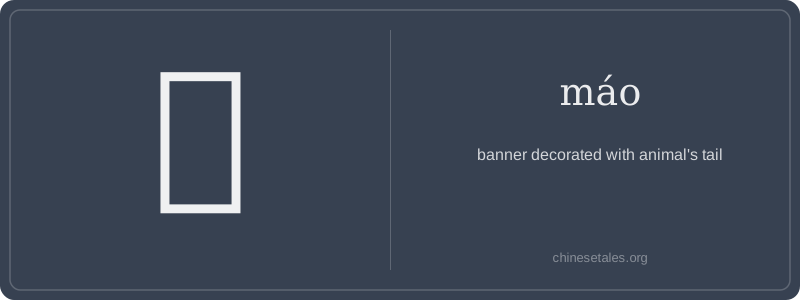
The earliest form of 旄 appears in late Shang bronze inscriptions as a clear pictograph: a vertical pole (丨) topped by three flowing, curving strokes representing a long animal tail — likely from a yak or ox — swaying in the wind. Over time, the tail simplified into three horizontal strokes (彡), while the pole merged with the radical 方 (originally a square enclosure, later repurposed for directional standards and banners). By the Qin small seal script, the structure solidified: 方 on the left anchoring the meaning of ‘official standard’, and 彡 on the right capturing the visual essence of the fluttering tail — no longer just fur, but *ritual motion*.
In the Book of Songs (Shījīng), 旄 appears in odes describing royal processions: ‘The lord’s máo waves high — his virtue fills the four quarters.’ Confucius himself referenced 旄-bearers as paragons of dignified conduct. Later, during the Han dynasty, 旄 became synonymous with diplomatic authority — Su Wu famously held a 旄节 (máo jié) — a bamboo staff capped with yak tail — for 19 years in exile, refusing to surrender it even as the tail shed completely. The visual logic remains intact: 方 conveys institutional gravity; 彡 embodies the living, vulnerable symbol of that authority.
Imagine standing on a windswept battlefield in ancient China: bronze bells chime, war drums thunder — and above it all, a tall pole surmounted by a luxuriant yak tail flutters defiantly. That’s not just any banner — that’s a máo. The character 旄 doesn’t mean ‘flag’ in the generic sense; it evokes something ceremonial, aristocratic, and deeply symbolic — a standard carried only by high-ranking generals or envoys bearing royal authority. It’s not used in modern daily speech, but appears with poetic weight in classical texts, historical dramas, and formal literary descriptions.
Grammatically, 旄 is almost always a noun — and nearly always part of a compound (like 旌旄 or 牦旄), never standing alone in modern usage. Learners sometimes misread it as ‘mao’ meaning ‘hair’ (毛) or confuse it with ‘mao’ meaning ‘cat’ (猫), but 旄 carries zero colloquial warmth — it’s austere, archaic, and visually precise. You’ll never see it on a subway ad or in a WeChat message. Its presence signals deliberate stylistic choice — like quoting Shakespeare mid-conversation.
Culturally, the yak-tail banner wasn’t mere decoration: it signified legitimacy, command, and ritual purity. Mistaking 旄 for 毛 (hair) isn’t just a slip — it collapses millennia of military hierarchy into a fuzzy eyebrow. And while the character looks simple (10 strokes!), its radical 方 (‘square’, ‘direction’, ‘method’) hints at order and official function — not randomness. So when you see 旄, don’t think ‘fluffy thing’ — think ‘command post with ceremonial flair’.