旆
Character Story & Explanation
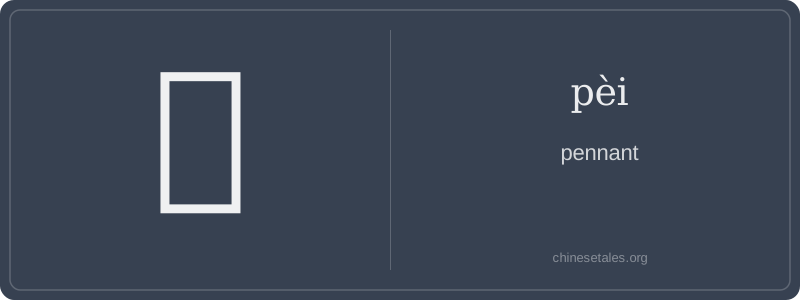
The earliest form of 旆 appears in bronze inscriptions from the late Shang and Western Zhou dynasties — not as a standalone pictograph, but as part of larger clan emblems. It combined a ‘square’ element (the ancestor of 方 fāng, the radical) representing a fixed, authoritative base, and flowing, wavy lines descending from its right side — unmistakably depicting fabric ribbons or tassels streaming in the wind. Over centuries, the wavy lines hardened into the three-stroke ‘巿’ component (fú, meaning ‘ceremonial cloth’), while the left ‘方’ became stylized but retained its sense of structural grounding. By the Han dynasty seal script, the character had stabilized into its current 10-stroke form: 方 + 巿 — a perfect visual metaphor: authority anchored, yet expressive in motion.
This duality shaped its meaning: 旆 wasn’t just *a* banner — it was the *commander’s* banner, distinguished by length, tassels, and placement. The Shijing (Book of Odes) mentions ‘白旆央央’ — ‘white pennants gleaming brightly’ — linking it to ritual processions and military muster. Later, in Tang poetry, Du Fu used 旆 to evoke melancholy grandeur: ‘风掣红旗冻不翻’ subtly echoes 旆’s kinetic stillness — a banner frozen mid-flutter, symbolizing halted ambition. Even today, its shape whispers motion: those three downward strokes aren’t random — they’re tassels caught in wind, forever falling, never still.
Imagine you’re standing on a windswept battlefield in ancient China — banners snap like thunder, and one in particular catches your eye: a long, fluttering pennant with ornate tassels, mounted high on a pole. That’s a pèi: not just any flag, but a ceremonial military standard carried by generals, rich with rank, identity, and ritual gravity. In modern Chinese, 旆 is rare in daily speech but thrives in literary, poetic, or historical contexts — it evokes grandeur, authority, and motion. You’ll never hear ‘I bought a 旆’ at a souvenir shop; instead, it appears in phrases like ‘旌旗飘旆’ (banners fluttering proudly), where it intensifies the visual drama of movement and dignity.
Grammatically, 旆 functions almost exclusively as a noun, often appearing in compound words or classical-style parallel constructions. It rarely stands alone — you won’t say ‘那是个旆’; rather, it’s embedded: ‘青旆’ (blue pennant), ‘素旆’ (plain white pennant), or paired with other banner-related characters like 旌 (jīng) or 幡 (fān). Learners sometimes misread it as a generic ‘flag’ (旗 qí), but that’s like calling a Fabergé egg ‘an egg’ — technically true, but missing all the artistry and context.
Culturally, 旆 carries Confucian-tinged solemnity: it signaled command, loyalty, and cosmic order — think of it as the ancient equivalent of a general’s shoulder insignia *plus* a wind-chime heralding their arrival. A common mistake? Assuming it’s interchangeable with 旗 or 帜 (zhì). But 旗 is utilitarian (a national flag, a traffic flag), while 旆 is performative, poetic, and almost always vertical, narrow, and tasseled. Its rarity makes it a ‘literary spice’ — used sparingly to add archaic flavor, much like saying ‘hither’ instead of ‘here’ in English.