旵
Character Story & Explanation
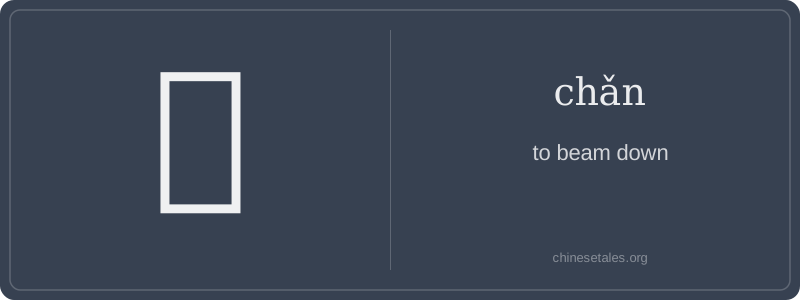
The character 旵 first appeared in late Han dynasty steles and early Tang calligraphy — not in oracle bones or bronzes — as a deliberate fusion of two ancient components: 日 (rì, 'sun') on the left, and 岾 (qǐng, an archaic variant of 岑 meaning 'steep mountain peak') on the right. Visually, it depicts the sun positioned directly above a sharp, towering summit — not shining *on* the mountain, but *aiming down* from the heavens *onto* its apex. Over centuries, 岾 simplified into the current right-hand form (a stylized peak with a horizontal stroke atop two diagonal strokes), while 日 retained its full, unambiguous solar disk shape — preserving the core image of celestial targeting.
This visual logic drove its semantic evolution: from a concrete description of sunlight striking a mountaintop at dawn (seen in Tang frontier poetry), to a metaphor for heavenly mandate descending upon virtuous rulers (in Song Neo-Confucian commentaries), and finally to its modern literary sense of 'auspicious, intentional beaming'. In the 11th-century *Guangyun* rhyme dictionary, 旵 is glossed as 'light descending clearly and brilliantly' — emphasizing both directionality and clarity. Its form remains a rare, elegant fossil of Chinese cosmological thinking: light as a sovereign act, not a passive phenomenon.
Think of 旵 like a celestial spotlight — not the beam itself, but the *act* of that light being deliberately directed downward from above, as if heaven were aiming a divine flashlight. It’s not about brightness (like 明) or radiance (like 熠), but about *intentional, vertical descent*: sunlight piercing clouds, auspicious light falling on a newborn, or even poetic descriptions of imperial grace descending upon the realm. This is a literary, almost ritualistic verb — you won’t hear it in daily chat, but you’ll find it in classical poetry, temple inscriptions, and formal blessings.
Grammatically, 旵 is almost always transitive and used in compound verbs or literary passive constructions. It rarely stands alone; instead, you’ll see it in phrases like 旵照 (chǎn zhào, 'to beam upon') or 旵臨 (chǎn lín, 'to descend auspiciously'). Learners often mistakenly treat it like a simple synonym for 照 (zhào, 'to shine'), but 旵 carries weight: it implies reverence, destiny, and top-down sacred agency — like saying 'the sun ordained this moment' rather than 'the sun lit up the room'.
Culturally, 旵 evokes Daoist cosmology and imperial ritual language — where light isn’t just physics, but cosmic approval. A common mistake is overusing it in modern contexts (e.g., writing '阳光旵在我脸上' — which sounds absurdly grandiose). Also, note its pronunciation: chǎn rhymes with 'shawn', not 'chan' — mispronouncing it as chān or chàn strips it of its ceremonial cadence. Its rarity means even many native speakers pause before using it — it’s the linguistic equivalent of pulling out a hand-carved lacquer box for tea, not your IKEA mug.