昡
Character Story & Explanation
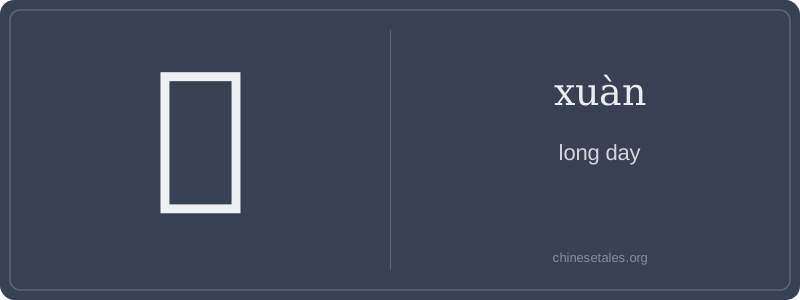
The earliest attested form of 昡 appears in late Warring States bamboo manuscripts — not oracle bones, but ink-on-bamboo inscriptions where scribes elongated the 日 (rì, 'sun') component vertically and added two parallel horizontal strokes above it, like sunbeams stretching downward. Over centuries, clerical script simplified those beams into the top two strokes of today’s form, while the 日 base remained anchored at the bottom — visually mirroring the idea of daylight persisting, sinking slowly, refusing to end.
This character flourished briefly in early Han dynasty astronomical records and seasonal almanacs, where it denoted days exceeding standard length during solstices — not just calendar days, but phenomenological ones: days that *felt* longer due to heat, stillness, or ritual observance. In the Shuōwén Jiězì (c. 100 CE), Xu Shen classified it under 日, defining it tersely as 'rì cháng yě' (‘a long day’), confirming its semantic anchor in duration rather than intensity. By the Tang dynasty, it had faded from active use, surviving only in rhyme dictionaries and commentary margins — a quiet monument to how deeply ancient Chinese observed the body’s experience of time.
Let’s cut to the chase: 昡 (xuàn) is a ghost character — elegant, ancient, and nearly extinct. Its core meaning is 'a long day' or 'prolonged daylight', evoking the slow, heavy passage of time under an unrelenting sun. It doesn’t mean 'day' in the general sense (that’s 日 rì), nor does it imply brightness (like 炫 xuàn, which sounds identical but means 'to dazzle'). Instead, 昡 carries a poetic, almost melancholic weight — think of midsummer afternoons that stretch like taffy, where heat blurs the edges of hours.
Grammatically, 昡 is not used independently in modern speech or writing. You won’t find it in textbooks, apps, or daily conversation — it’s absent from HSK, government word lists, and even most dictionaries outside classical or lexicographic references. When it *does* appear, it’s almost always as part of rare literary compounds (e.g., 昡晝 xuàn zhòu — 'extended day') or in historical glosses on ancient texts. Learners might stumble upon it in pre-Qin bamboo-slip transcriptions or Song-dynasty philological notes — but never in a WeChat message.
Culturally, 昡 is a linguistic fossil reminding us how precisely Chinese once measured temporal experience. Unlike English, which relies on phrases ('endless afternoon'), Classical Chinese could encapsulate duration + light + fatigue in one glyph. A common mistake? Confusing it with 炫 (xuàn, 'to show off') due to identical pronunciation and similar stroke density — but while 炫 shouts, 昡 sighs. Also beware: its radical isn’t what you’d expect — it’s actually 日 (sun/day), not 心 (heart) or 氵 (water), despite the visual impression of 'flowing light'.