昣
Character Story & Explanation
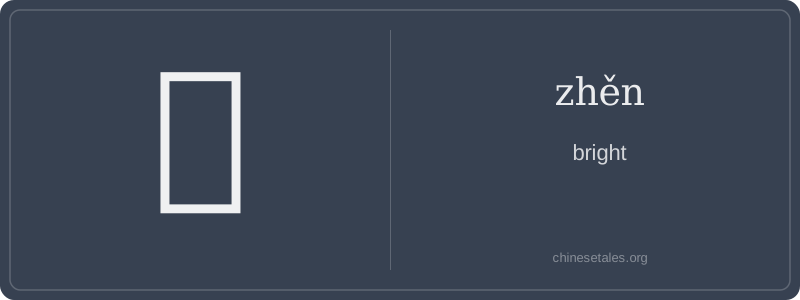
The earliest form of 昷 appears in bronze inscriptions as a combination of 日 (rì, 'sun') atop 人 (rén, 'person'), but crucially — with the person depicted kneeling under radiant lines. This wasn’t just sunlight falling on a figure; it was the moment of enlightenment: human consciousness pierced by celestial clarity. Over centuries, the kneeling person simplified into 㐱 (a rare variant radical meaning 'to attend carefully'), while the sun morphed into the top 日 component — preserving the core idea: luminosity *attending* the mind. By the Han dynasty, the form stabilized as 昷 — though scribes occasionally wrote it with 目 (mù, 'eye') instead, emphasizing perceptual sharpness.
In the Zhuangzi, 昷 describes the 'unclouded vision' of the perfected person — not optical brightness, but the ability to see reality without egoic distortion. Later, Tang poets used 昷智 to praise ministers whose judgment shone through political fog. Its visual logic remains elegant: 日 (sun/light) governing 㐱 (attentive human presence) = brightness born of mindful awareness. That’s why it’s never just 'bright' — it’s brightness *earned*.
Let’s be honest: 昣 (zhěn) is a quiet rebel — it means 'bright' or 'brilliant', but it’s almost never used alone in modern speech. Think of it as the poetic whisper behind words like 'luminous insight' or 'radiant clarity'. It doesn’t shout; it glows with classical restraint. In classical Chinese, it often modified nouns abstractly — like 昣光 (zhěn guāng, 'penetrating light') or 昣智 (zhěn zhì, 'keen wisdom') — suggesting not just physical brightness, but mental acuity and moral lucidity.
Grammatically, 昣 functions almost exclusively as a literary adjective, usually in two-character compounds or parallel phrases in formal writing, poetry, or philosophical texts. You won’t hear it in daily conversation ('This lamp is 昣' sounds deeply unnatural), and trying to use it like 明 (míng, 'bright') will instantly mark you as someone quoting Zhuangzi rather than ordering coffee. It’s also tone-sensitive: zhěn is third tone — think of it as a downward flick, like dimming a candle then catching its last sharp gleam.
Culturally, 昣 carries Confucian and Daoist resonance: brightness here isn’t flashy illumination, but the inner clarity of a sage who sees truth without distortion. Learners often misread it as 真 (zhēn, 'true') due to similar sound and stroke density — a tiny slip that swaps 'luminous perception' for 'authenticity'. Worse, some force it into colloquial contexts ('The screen is 昣!'), which native speakers would gently correct with a smile and a switch to 亮 (liàng) or 明 (míng).