暌
Character Story & Explanation
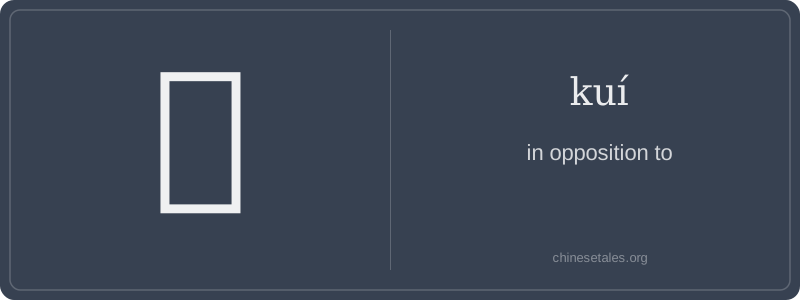
The earliest form of 暌 appears in Warring States bamboo slips as a vivid pictograph: two eyes (目) placed left and right of a central element — not the modern 日, but originally something like 卜 or 丿, symbolizing a dividing line or barrier. Over centuries, the central element standardized into 日 (sun), perhaps because scribes associated celestial bodies with cosmic order — and thus, disorder when alignment failed. The left eye evolved into 夂 (a variant of 止, ‘to stop’), while the right became 目 — but crucially, both ‘eyes’ face outward, never toward the center. Stroke by stroke, it solidified: top-left 夂 (3 strokes), then 日 (4), then bottom-right 目 (5), totaling 13 — a number echoing the ‘thirteen heavens’ of Daoist cosmology, where misalignment spans all layers of existence.
This visual duality shaped its meaning: from literal ‘looking apart’ in early texts like the *Zuo Zhuan*, it matured into abstract estrangement — moral, geographic, temporal. By the Tang dynasty, poets like Du Fu used 暌 in lines mourning severed ties with court and kin. Confucian commentators noted how 暌 described not mere distance, but the *failure of reciprocity*: if one bows, the other must rise; if one speaks, the other must listen — 暌 is the silence *between* those gestures. Its presence in classical texts signals profound rupture, never trivial discord — making it a quiet powerhouse in China’s literary emotional vocabulary.
Think of 暌 (kuí) as Chinese for 'cosmic misalignment' — like two planets stubbornly refusing to orbit in sync, or a pair of mismatched socks that *insist* on staying separate. Its core meaning isn’t just ‘opposed’ but carries weighty, almost fated separation: not temporary disagreement, but deep-seated divergence — of wills, paths, or principles. It’s literary, formal, and emotionally charged, rarely used in casual speech (you’d never say ‘kuí wǒ de yìjiàn’ to your roommate about pizza toppings).
Grammatically, 暌 most often appears in compound verbs or set phrases, especially after subject + structure like ‘与…暌违’ (yǔ… kuíwéi, ‘to be estranged from…’) or in the four-character idiom 暴戾恣睢 (bàolì zìsuī — wait, no — that’s unrelated! Don’t confuse it! Correct one: 暴戾恣睢 doesn’t contain 暌 — a classic trap!). Real usage: ‘他与故乡暌违三十年’ — here 暌 is bound tightly with 违; they function as a fixed disyllabic verb meaning ‘to be separated from’. You won’t find 暌 standing alone as a verb — it’s a linguistic duo artist, always needing its partner.
Culturally, 暌 evokes classical poignancy — the ache of scholars exiled far from home, lovers parted by war, or ideals drifting from reality. Learners often misread its radical 日 (sun) as suggesting brightness or time, missing the ancient visual logic: those two ‘eyes’ (目) flanking the sun aren’t watching — they’re *looking away from each other*. A frequent mistake is pronouncing it ‘guī’ (like 归) — but kuí rhymes with ‘sky’, a subtle cue: when things are *in opposition*, they’re literally looking up — and past one another.