暠
Character Story & Explanation
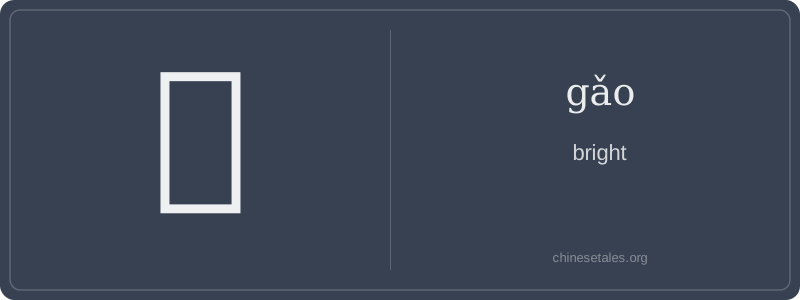
The earliest form of 暠 traces back to small-seal script (c. 200 BCE), where it combined 日 (rì, 'sun') on the left — unmistakably pictorial, like a circle with a dot — and 皐 (gāo, later simplified to 皋), a phonetic component meaning 'high riverbank', suggesting elevation and openness. Over centuries, 皐 evolved into the right-hand side we see today: two horizontal strokes (一), a vertical stroke (丨), then a 'lid' radical (丷 + 儿), stylized from ancient depictions of raised land near water — reinforcing the idea of unobstructed, high-reaching light.
This visual logic shaped its meaning: sun rising over open, elevated terrain = pure, unclouded brightness. In the Classic of Poetry (Shījīng), 暠 appears in rare variants describing 'the clear dawn sky'; by the Tang dynasty, poets like Li Bai used 暠月 ('brilliant moon') to evoke transcendent stillness. Its enduring charm lies in how its structure — sun + high ground — encodes not just light, but *unimpeded* light: morally clear, aesthetically serene, spiritually elevated.
Think of 暠 (gǎo) as the 'sunshine on polished jade' kind of brightness — not just literal light, but luminous clarity, noble radiance, or serene brilliance. It’s poetic and elevated: you won’t hear it in casual chat ('The lamp is bright' is míng, not gǎo), but in classical allusions, names, or literary descriptions where brightness carries moral or aesthetic weight — like describing a sage’s wisdom or dawn breaking over misty mountains.
Grammatically, 暠 functions almost exclusively as an adjective, usually before nouns (e.g., 暠月 'brilliant moon') or in fixed binomial compounds. It rarely stands alone and never takes aspect markers (no 暠了 or 暠过). Learners often mistakenly use it like 明 (míng) or 亮 (liàng), but that’s like swapping 'resplendent' for 'bright' in English — technically correct, but tonally jarring in most contexts. It also appears in personal names (e.g., 李暠), where its elegance signals refinement.
Culturally, 暠 evokes Tang and Song dynasty aesthetics — think ink-wash landscapes where light isn’t just illumination, but spiritual presence. A common pitfall? Confusing it with 烜 (xuǎn, 'blazing') or 曄 (yè, 'glittering'), both visually similar but carrying hotter, flashier connotations. 暠 is cool, calm, and deep — like sunlight reflected off still water, not firelight.