曛
Character Story & Explanation
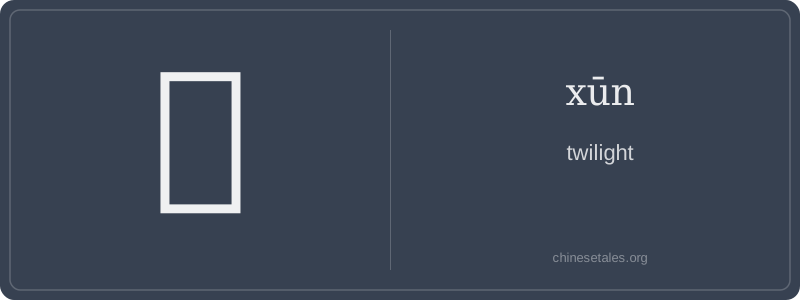
The earliest form of 曛 is not found in oracle bones, but emerged later in seal script (around 3rd century BCE), where it fused two key elements: 日 (sun, radical) on the left, and 熏 (xūn, meaning 'to smoke, to permeate') on the right. Visually, the right side originally depicted fire beneath a cover — a cauldron emitting fragrant, rising fumes. Over centuries, the seal script simplified into clerical script, then regular script: the 日 kept its square clarity, while 熏 lost some strokes but retained its core structure — three ‘fire’ dots (灬) stacked under a ‘black’ (黑) component, eventually stylized into the modern 熏 shape. The full character thus became a visual metaphor: sun + permeating glow.
This fusion wasn’t accidental. Ancient poets observed how twilight doesn’t vanish — it *infuses* the landscape, like smoke or incense filling a room: subtle, pervasive, warm, and ephemeral. In the Wen Xuan (Selections of Refined Literature, 6th c. CE), 曛 appears in descriptions of rivers bathed in '曛光' — light so tender it seemed breathed onto the world. Its meaning never strayed from this poetic core: not just 'twilight', but twilight *as atmospheric presence*. Even today, its stroke count (18) mirrors its weight — neither light nor heavy, but richly layered, like dusk itself.
Imagine standing on a quiet riverside at dusk: the sun has just dipped below the hills, the sky blazes in soft apricot and lavender, and the air cools with a hush — that precise, fleeting, poetic moment is what 曛 captures. Unlike generic words like 晚上 (evening) or 黄昏 (twilight, more colloquial), 曛 is literary, evocative, and almost tactile — it’s the *quality* of light at day’s edge, not just the time. It’s rarely used alone; instead, it appears in compound nouns or poetic phrases, always carrying a gentle melancholy or serene reverence.
Grammatically, 曛 functions almost exclusively as a noun modifier or in fixed two-character compounds (e.g., 曛色, 曛光). You’ll never hear someone say '今天很曛' — that’s ungrammatical and would confuse native speakers. Instead, it’s embedded: '曛色渐浓' (the twilight hue deepens), '披着曛光' (bathed in twilight light). Learners often misplace it like an adjective or verb, but it’s a noun-rooted, classical lexical fossil — think of it as Chinese poetry’s 'vermillion hour', not everyday vocabulary.
Culturally, 曛 appears in Tang and Song dynasty poetry to evoke transience and quiet beauty — Du Fu and Wang Wei used it to mark emotional turning points. Modern usage is rare outside literature, calligraphy, or lyrical song lyrics. A common mistake is overusing it in spoken Mandarin; it sounds archaic or pretentious if forced. Also, don’t confuse it with similar-looking characters like 昏 or 暮 — 曛 isn’t about darkness arriving, but about light *lingering*, glowing, and softening.