朅
Character Story & Explanation
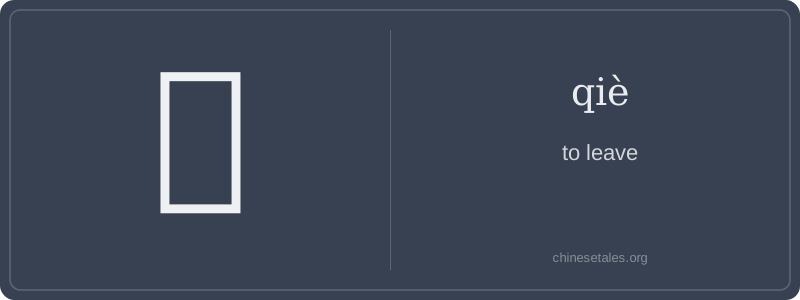
The earliest form of 朅 appears in Warring States bamboo slips — not oracle bones, since it’s relatively late — where it combines the moon radical 月 (originally flesh/muscle, later semantic for body-related actions) with 去 (qù, 'to go away'). Wait — but isn’t that redundant? Not quite. The left side is actually the 'flesh' radical (⺼), often mistaken for 月, and the right is 去 with an added horizontal stroke on top, possibly indicating intentional, decisive departure. Over centuries, the flesh radical simplified visually into 月 shape, while the right component stabilized into today’s 去-like form — though crucially, it’s not 去: notice the extra tiny hook on the upper-left corner of the right-hand part.
This character first surfaced meaningfully in the Chu Ci (Songs of Chu), where Qu Yuan uses 朅 in lines evoking spiritual departure from corruption: '朅吾游乎昆仑之墟' ('Let me depart and wander the Kunlun hills'). Here, 朅 conveys transcendent withdrawal — not physical motion alone, but moral and metaphysical severance. Its visual structure reinforces this: flesh (body/self) + controlled, marked departure = the self consciously exiting a compromised realm. That philosophical gravity is why it never entered vernacular use — too heavy for everyday fare.
Let’s get real: 朅 (qiè) is a linguistic ghost — elegant, rare, and almost extinct in modern speech. It means 'to leave' or 'to depart', but not in the casual sense of 'I’m leaving now'. Think more like poetic, classical departure: a scholar abandoning his post, a hero riding off into misty mountains. It carries weight, solemnity, even melancholy — like the final bow before exile. You’ll almost never hear it in daily conversation; it lives in classical poetry, historical texts, and literary allusions.
Grammatically, 朅 functions as a verb, often at the start of a clause, and frequently appears in parallel structures or with classical particles like 乃 or 遂. Unlike common verbs like 离开 (líkāi), 朅 doesn’t take aspect markers (了, 过, 着) easily — trying to say *朅了 sounds jarringly wrong to native ears. It resists modern grammar like a scholar refusing to wear sneakers to court. Its usage is tightly bound to elevated register: think Su Shi’s essays or Tang dynasty yuefu poems, not WeChat messages.
Culturally, learners often misread 朅 as a variant of 去 (qù, 'to go') or 憩 (qì, 'to rest') — both dangerous assumptions. Its rarity means even advanced learners may overlook it entirely, yet encountering it in classical texts can stall comprehension completely. A key trap? Assuming it’s interchangeable with other 'departure' verbs — but 朅 implies irrevocable, dignified withdrawal, not routine travel. It’s less 'I’m off to the store' and more 'I forsake this world forever'.