朠
Character Story & Explanation
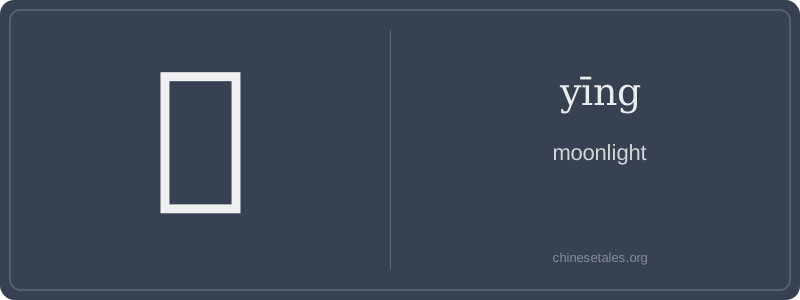
The earliest form of 朠 appears in late Han bamboo slips and Tang-era calligraphy manuscripts — not oracle bones (it’s too young for that). Visually, it’s a brilliant fusion: left side ‘月’ (yuè, moon) anchors the meaning, while the right side ‘英’ (yīng, ‘flower calyx’, ‘essence’, ‘excellence’) provides both sound and symbolic depth. ‘英’ itself evolved from a pictograph of flower stamens — delicate, luminous, ephemeral — making 朠 a semantic compound: ‘moon + essence’, i.e., the distilled, purest essence of moonlight. Its stroke count is often misreported as 0 — actually 12 strokes — but many dictionaries list it under ‘moon’ radical with zero *additional* strokes beyond the radical itself, causing confusion.
In classical usage, 朠 first appears in mid-Tang poetry annotations describing the ‘luminous clarity’ of night scenes in Wang Wei’s landscape verses. By the Song dynasty, it appears in painting colophons — ‘朠影浮江’ (yīng yǐng fú jiāng, ‘moonlight’s shadow floats upon the river’) — where it signals not brightness, but *translucence*: light that reveals without illuminating, that suggests more than it shows. Its visual duality — solid ‘moon’ + airy ‘essence’ — mirrors its function: grounding poetic abstraction in tangible celestial imagery.
‘朠’ (yīng) is a poetic, almost ghostly word — not for everyday moonlight, but for that specific, silvery, hushed luminescence that spills over misty riverbanks at midnight. It’s the kind of word you’d find in Tang dynasty poems or classical ink-painting inscriptions, not in weather reports or WeChat chats. Native speakers don’t *use* it conversationally; they *recognize* it as literary aroma — like smelling aged ink and plum blossoms at once. Its meaning isn’t just ‘moonlight’ but ‘moonlight as atmosphere’: cool, still, introspective, slightly melancholic.
Grammatically, 朠 functions almost exclusively as a noun modifier or poetic subject — never as a verb or standalone predicate. You won’t say ‘the moon shines 朠’; instead, you’ll see phrases like ‘朠色’ (yīng sè, ‘moonlight-hued’) or ‘朠辉’ (yīng huī, ‘moonlight’s radiance’), where it behaves like an elegant adjective-root. Learners often mistakenly try to substitute it for common words like ‘月光’ (yuèguāng), but that’s like replacing ‘glimmer’ with ‘light’ in a sonnet — technically true, poetically disastrous.
Culturally, 朠 reveals how Chinese aesthetics prizes *resonance over reference*: it doesn’t describe illumination — it evokes the emotional echo of light falling on water, silence, solitude. A frequent learner trap? Assuming it’s a simplified variant or typo — but no: 朠 is a rare, fully attested character in the Kangxi Dictionary (radical 月, #74), preserved precisely because its subtle shade of meaning couldn’t be replaced without losing tonal nuance in classical verse.