杕
Character Story & Explanation
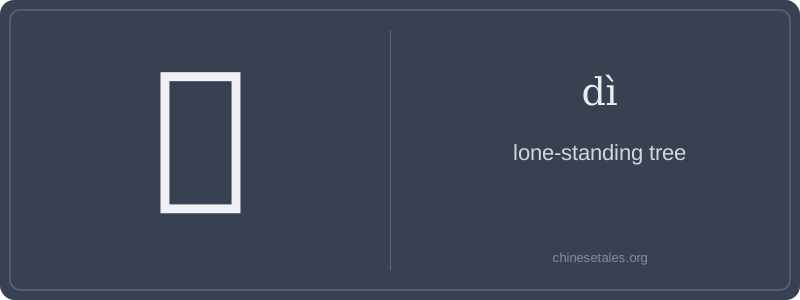
The earliest form of 杕 appears in late Warring States bamboo slips as a highly stylized pictograph: a vertical trunk (丨) with two asymmetrical, upward-sweeping branches (丿 and 乀), plus a small dot (丶) beneath — representing roots anchoring into earth. Over centuries, the branches simplified into the top component 木 (tree), while the dot fused with the trunk to form the lower part 弟 (dì, 'younger brother'), lending both sound and symbolic contrast: the 'younger brother' stands apart, not subordinate. By the Han dynasty clerical script, the shape stabilized into today’s 杕 — a tree that *chooses* aloneness.
This visual duality — wood + 'younger brother' — seeded its semantic evolution. In the Shuōwén Jiězì (121 CE), Xu Shen defined it as 'a tree standing singly, unsheltered by others', linking solitude not to abandonment but to moral autonomy. Tang poets like Wang Wei used 杕 to symbolize the enlightened recluse — one who withdraws not from failure, but from distraction. Its rarity today isn’t decline; it’s preservation — like a living fossil of Chinese aesthetic philosophy.
Imagine walking alone at dusk through an ancient, mist-shrouded forest in southern China — and suddenly spotting it: a single, gnarled camphor tree standing apart from the grove, its roots gripping bare rock, branches stark against the violet sky. That’s 杕 (dì): not just 'a tree', but *the* tree — solitary, dignified, quietly defiant. In classical Chinese, it evokes poetic loneliness and resilience, never mere botany. It’s not used for orchards or timber; it’s literary, almost philosophical — like calling a person ‘a lone pine’ in English poetry.
Grammatically, 杕 is almost exclusively a noun, rarely appearing in modern spoken Mandarin. You’ll find it only in classical allusions, poetic couplets, or place names (e.g., 杕山 Dì Shān — Lone-Tree Mountain). It doesn’t take measure words like 棵 or 株; you’d say 一杕 (yī dì) — yes, the character itself doubles as a rare, archaic classifier! Learners often misread it as 狄 (dí, 'northern nomads') or assume it’s a variant of 某 (mǒu, 'certain'), but neither fits semantically or phonetically.
Culturally, 杕 carries subtle Daoist and Chan Buddhist resonance — the image of singularity amid multiplicity, stillness within change. Mistaking it for common tree characters like 林 (lín, 'grove') or 森 (sēn, 'dense forest') flips the meaning entirely: where those imply community and abundance, 杕 whispers solitude and integrity. It’s a character that rewards slowness — best savored in calligraphy, not flashcards.