杗
Character Story & Explanation
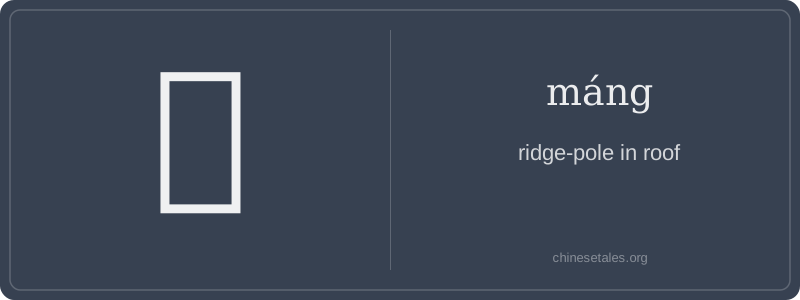
The earliest form of 杗 appears in bronze inscriptions from the late Shang and early Zhou dynasties—not as a pictograph of wood, but as two parallel horizontal lines (representing rafters) crossed by a bold, thick vertical stroke (the central ridge-pole), with small hooks or dots at the ends suggesting carved tenon joints. Over centuries, the top line simplified into the ‘shù’ radical (一丨), the middle thick stroke became the prominent vertical ‘gān’-like core, and the lower part evolved into the ‘mù’ (wood) component — visually anchoring its material essence. By the Small Seal script, it had stabilized into its current structure: a strong vertical backbone flanked by balanced, supportive strokes.
This character’s meaning never wavered—it always meant the central ridge-beam—but its cultural weight deepened. In the Kaogongji (c. 3rd century BCE), China’s earliest technical manual on craftsmanship, the máng was specified down to the exact timber species and curvature radius required for ritual buildings. Later, poets like Du Fu used it metaphorically: ‘Wūmáng yù duàn fēng shēng jí’ (The ridge-pole seems about to snap—the wind howls fiercely), turning architecture into emotional tension. Its shape—a sturdy vertical line rooted in wood—mirrors its function: silent, central, indispensable.
Imagine you’re standing beneath the soaring, curved roof of a Song-dynasty temple in Kaifeng—dust motes dancing in sunbeams as your gaze travels up to the very top, where two massive wooden beams meet at the peak, holding the entire structure aloft like a quiet, unblinking spine. That central beam? That’s the máng—the ridge-pole. It’s not just lumber; in classical Chinese architecture and thought, the máng symbolizes structural integrity, hidden authority, and the quiet strength that makes everything else possible. You’ll almost never hear it in daily speech—it’s literary, architectural, or poetic.
Grammatically, 杗 is a noun only—never used as a verb or modifier—and appears almost exclusively in formal compound terms (like wūmáng) or classical descriptions. Learners sometimes misread it as máng meaning ‘busy’ (忙) or ‘blind’ (盲), but those share only the sound, not the sense or shape. Crucially, 杗 never stands alone in modern usage—you won’t say ‘this is a máng’ without context. Instead, it lives inside phrases describing roofs, restoration projects, or poetic metaphors for foundational support.
Culturally, this character quietly anchors a worldview: what holds up the heavens (the roof) must be strong, centered, and invisible to most—but without it, collapse is inevitable. Mistake it for other máng characters, and you’ll accidentally call a beam ‘busy’ or ‘blind’. Worse, its absence from HSK means many learners never encounter it—until they read an article about heritage conservation or a Tang poem describing ‘the wind shaking the wūmáng’—and suddenly, this tiny, ancient word becomes the keystone of understanding.