杷
Character Story & Explanation
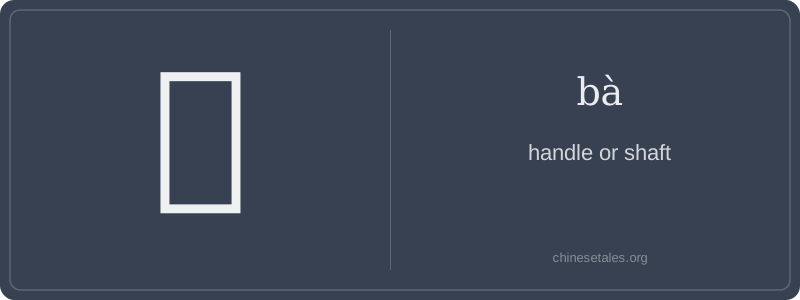
The earliest form of 杷 isn’t found in oracle bones (it’s too late for that), but its structure tells a clear story: left side 木 (mù, 'tree/wood') + right side 巴 (bā, originally a pictograph of a snake’s coiled tail or a grasping hand). In bronze inscriptions and seal script, 巴 looked like a curved line gripping downward — evoking the act of wrapping fingers around something long and cylindrical. Over time, 巴 simplified into its modern square-ish shape, while 木 remained steadfastly woody. So 杷 literally means 'wooden thing you grip' — no metaphor, no abstraction: pure material + action.
This meaning held steady across millennia. In the *Tiangong Kaiwu* (1637, 'Exploitation of the Works of Nature'), Song Yingxing describes hoe handles (锄杷) and sickle shafts using 杷, always specifying wood type and taper. Interestingly, 杷 and 柄 were near-synonyms in classical texts, but 杷 emphasized raw material (wood) and ergonomics (grip), while 柄 leaned toward function and precision. Even today, if a traditional inkstone has a carved dragon head on its 杷, it’s not decoration — it’s a weight-balancing feature, proving this character’s enduring link between form, force, and finger-feel.
Think of 杷 (bà) as the unsung hero of tools — not the flashy blade or the clever gear, but the solid, reliable part you grip: the handle or shaft. In Chinese, it’s not a standalone noun you’d drop into casual chat like 'I need a new 杷' — instead, it lives inside compound words (like 刀把 or 柄把) and often appears in technical, craft, or classical contexts. Its feel is tactile and functional: wooden, grounded, unglamorous but essential. You’ll rarely hear it alone — it’s more like the quiet bassline than the melody.
Grammatically, 杷 almost always appears after another noun (e.g., 刀把 — 'knife handle'), forming a noun-noun compound where the second character specifies the part. It doesn’t take measure words or plural markers; it’s inherently singular and concrete. Learners sometimes mistakenly treat it like a verb ('to handle') or confuse it with 把 (bǎ), the versatile coverb — but 杷 has zero grammatical function beyond naming that physical extension. Try saying '这把刀的把是木头的' — notice how 把 (bǎ) and 杷 (bà) appear side by side? That’s a classic tongue-twister moment!
Culturally, 杷 carries the quiet dignity of craftsmanship — think of a master carpenter testing the balance of a chisel’s shaft, or a calligrapher selecting a brush with just the right 杷 length for wrist control. It’s absent from HSK because modern spoken Mandarin prefers simpler terms like 柄 (bǐng) or even just 柄子, but 杷 persists in dictionaries, tool manuals, and regional dialects (especially in northern China). A common mistake? Writing it as 把 when meaning 'handle' — which changes your sentence from 'the broom’s shaft' to 'hold the broom' — a total category shift!