枋
Character Story & Explanation
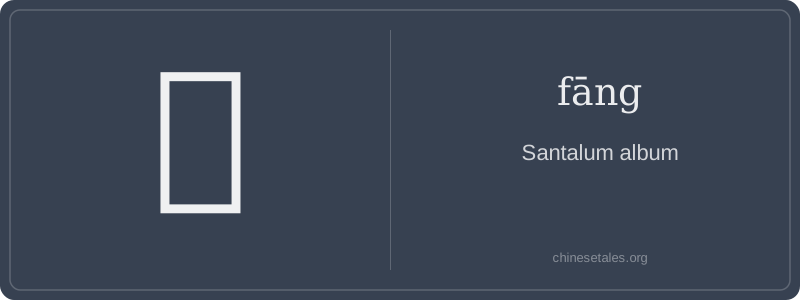
The earliest form of 枋 appears in Han-dynasty seal script: a left-side 木 (tree/wood) radical anchoring the character’s meaning, and a right-side ‘方’ (fāng) component — not as ‘square’, but as a phonetic loan. The oracle bone and bronze scripts don’t contain 枋; it emerged later as a specialized character for a specific imported timber. Visually, the modern 枋 retains that elegant balance: 木 (4 strokes) on the left, 方 (4 strokes) on the right — eight strokes total, mirroring the symmetry of a perfectly squared sandalwood beam. Each stroke is clean and deliberate: the dot and horizontal of 木’s top, the vertical trunk, then the two falling strokes; on the right, 方 begins with a dot, sweeps down-right, crosses horizontally, then finishes with a downward hook — a shape echoing both the grain’s straightness and the carpenter’s square.
Meaning-wise, 枋 began as a precise technical term in Tang-era pharmacopoeias like the *Xinxiu Bencao*, where it distinguished *Santalum album* from native ‘tan’ woods like 檀. By the Ming dynasty, cabinetmakers used 枋 specifically for fine-grained, fragrant structural elements — not just any beam, but one carved from this sacred wood. Classical poets like Li Shangyin referenced ‘fāng yān’ (sandalwood smoke) as a symbol of refined melancholy and impermanence. Over time, the architectural sense faded, leaving only the botanical identity — a rare case where a character shed its concrete, structural meaning to become purely lexical and ecological.
Imagine walking through a quiet temple courtyard in Suzhou, where the air smells faintly sweet and woody — not like pine or cedar, but something warmer, almost honeyed. An elderly craftsman points to a slender, pale-yellow timber beam resting on a workbench and says, 'Zhè shì fāng mù — zhēn zhèng de tán xiāng.' That’s 枋: not just any wood, but the rare, aromatic heartwood of *Santalum album*, Indian sandalwood — revered for centuries in Chinese medicine, incense rituals, and elite carving. In modern usage, 枋 is almost exclusively botanical or technical: it appears in herbal texts, forestry reports, or antique furniture descriptions — never in daily conversation or beginner textbooks (hence its absence from HSK). You’ll never say ‘I bought 枋’; you’ll read ‘fāng mù bèi jìn zhǐ yīn wéi guò dù cǎi fá’ (sandalwood banned due to overharvesting).
Grammatically, 枋 functions as a noun only — always preceded by classifiers like ‘yì kuài’ (a piece) or modifiers like ‘zhēn zhèng de’ (authentic) or ‘gǔ dài’ (ancient). It rarely stands alone; you’ll see it in compounds like ‘fāng mù’ (sandalwood) or ‘tán fāng’ (sandalwood, poetic variant). Learners sometimes misread it as fǎng (like 仿) or confuse it with 方 — but 枋 has no abstract meanings (no ‘method’ or ‘direction’), and it carries zero colloquial usage. Pronounce it firmly: fāng (first tone, flat and clear), like ‘fang’ in ‘fang tooth’ — but think ‘fragrant fang’.
Culturally, 枋 embodies a quiet paradox: though visually simple (just 8 strokes), it evokes layers of transnational history — imported from South Asia via maritime trade routes as early as the Tang dynasty, prized by emperors for its scent and incorruptibility, yet now critically endangered. Mistaking it for common wood terms like 松 (pine) or 柏 (cypress) misses its rarity and ritual weight. And crucially: in classical texts, 枋 occasionally meant ‘beam’ (architectural), but that sense is obsolete today — using it that way now sounds archaic or poetic, not technical.