枟
Character Story & Explanation
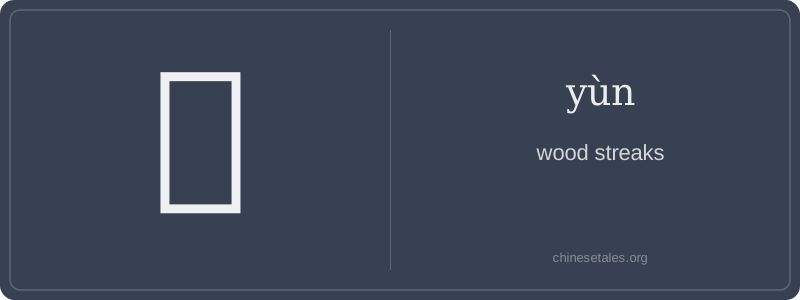
The earliest attested form of 枟 appears not in oracle bones — too rare and late for that — but in Han dynasty bronze inscriptions and early seal script. Visually, it combines the wood radical 木 (mù) on the left with 云 (yún, 'cloud') on the right. But here’s the twist: 云 wasn’t chosen for its meaning — clouds have nothing to do with wood grain. Instead, it was selected purely for its *sound*: yún matched the ancient pronunciation of the word for 'wood streaks'. This is a classic example of a phono-semantic compound (形声字), where one component hints at meaning (木 = wood), the other at pronunciation (云 = yún).
Over centuries, the right-hand 云 simplified from its full pictographic cloud shape (with curling strokes) into today’s streamlined form — losing its cloud-like curves but retaining phonetic function. Though 枟 never became common, it appears in early botanical texts and Song dynasty woodworking manuals describing timber quality. The character’s endurance lies precisely in this duality: its visual logic (wood + sound) makes it instantly legible to literate readers, while its rarity preserves a kind of lexical 'grain' — a textured remnant of how pre-modern Chinese scholars named the world’s subtlest physical details.
At first glance, 枟 (yùn) feels like a whisper from classical Chinese — not a word you’ll hear in street conversations or see on subway ads, but one that lives in the quiet reverence for natural texture. Its core meaning, 'wood grain' or 'wood streaks', isn’t just about physical patterns; it evokes the Chinese aesthetic principle of *zìrán* (naturalness) — the idea that beauty and authenticity lie in unforced, organic structure. Think of lacquered antique furniture or ink-brushed bamboo: the subtle, flowing lines of the wood aren’t flaws — they’re *character*, even *spirit*. That’s what 枟 carries: respect for inherent, unrepeatable patterning.
Grammatically, 枟 is almost exclusively a noun and appears only in literary, descriptive, or technical contexts — never as a verb or adjective, and never standalone in speech. You’ll find it in phrases like '木纹' (mù wén), where 枟 is the archaic or poetic variant of 纹 (wén, 'pattern'). It rarely takes modifiers directly; instead, it appears in compound nouns or as a subject in elegant written descriptions: '此枟细密如丝' (This wood grain is fine as silk). Learners often mistakenly treat it like a modern high-frequency character — but it has zero colloquial use, no verb forms, and no common adjectival derivatives.
Culturally, 枟 reveals how deeply Chinese thought links material texture to moral and philosophical resonance: grain mirrors destiny (*mìng*), growth rings echo time’s quiet passage, and irregularity signals authenticity — the opposite of mass-produced uniformity. A common learner trap? Assuming 枟 works like 纹 or 花 (huā, 'flower/pattern') in everyday speech. It doesn’t. Using it in casual chat would sound like quoting Tang poetry at a coffee shop — technically correct, beautifully odd, and utterly out of place.