枹
Character Story & Explanation
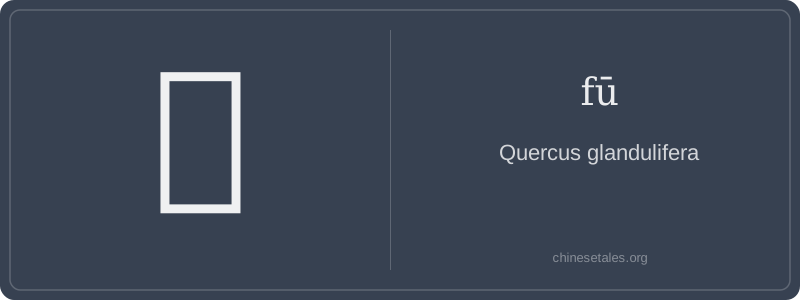
The character 枹 first appeared in seal script (around 200 BCE), evolving from a pictograph that combined two key elements: the 'wood' radical (木) on the left — unmistakably depicting a tree with trunk and branches — and the right side, which was originally a stylized rendering of the word 'fū' (a phonetic loan) derived from the ancient character 包 (bāo), meaning 'to wrap'. Over centuries, 包 simplified into the modern form now seen on the right — a visual echo of tightly wrapped acorn cups clinging to the twig. The seal script version already showed clear vertical symmetry and balanced stroke weight — a design optimized for carving on bamboo slips and bronze.
By the Tang dynasty, 枹 had settled into its current structure, appearing in Li Shizhen’s Bencao Gangmu (1596) to distinguish this oak from others like 槲 (hú) or 栎 (lì). Interestingly, its use was never poetic or metaphorical — unlike 柳 (willow) or 松 (pine), 枹 never entered idioms or poetry. Its identity remained stubbornly literal: a taxonomic marker for a specific, ecologically important hardwood. That fidelity to scientific accuracy — embedded in a character barely 2,200 years old — makes 枹 a quiet monument to early Chinese botany.
Let’s be honest: 枹 (fū) is a botanical deep-cut — not something you’ll hear in a Beijing café or see on a subway ad. It refers specifically to Quercus glandulifera, a species of oak native to East Asia, sometimes called the 'glandular oak' for its distinctive acorn scales. In Chinese, it carries a quiet, scholarly weight — less 'tree' and more 'botanical specimen', often appearing in classical herbals, regional forestry reports, or ecological surveys. You won’t find it in daily conversation, but when it appears, it signals precision: this isn’t just any oak — it’s that oak.
Grammatically, 枹 behaves like a standard noun — no special particles or verb forms — but here’s where learners trip up: it almost never stands alone. You’ll nearly always see it in compounds like 枹树 (fū shù, 'glandular oak tree') or 枹木 (fū mù, 'glandular oak wood'). Using it bare — say, '这是一枹' — sounds jarringly incomplete, like saying 'This is a *Quercus glandulifera*' in English without context. Native speakers instinctively pair it with a classifier or modifier.
Culturally, 枹 reflects how Chinese lexical richness thrives in specialized domains: medicine, botany, local dialects. Its rarity means even many native speakers outside forestry or southern China (where the tree grows) may not recognize it. A common mistake? Misreading it as 抱 (bào, 'to hug') — same right-hand component, totally different radical and meaning! Remember: 枹 is about roots, bark, and acorns — not arms or affection.