栒
Character Story & Explanation
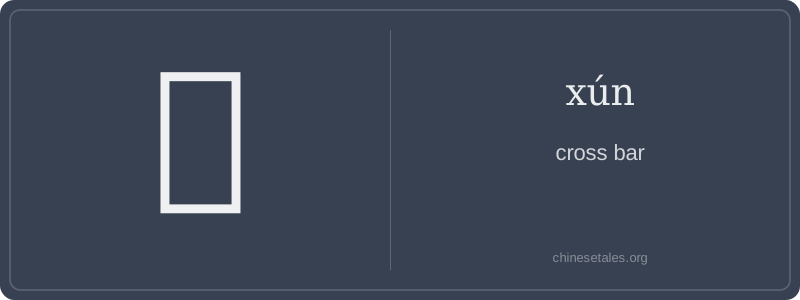
The earliest form of 栒 isn’t found in oracle bones — it’s a later invention, emerging around the Warring States period in bronze inscriptions and bamboo slips. Visually, it’s a clever fusion: the top horizontal stroke (一) represents the bar itself; below it, the 艹 (grass radical) originally symbolized layered wooden planks or latticework; and the right-side 句 (jù), with its curved hook, evolved from a pictograph of a bent timber joint — suggesting flexibility under load. Over centuries, the grass radical simplified, the curve of 句 sharpened into its modern angular form, and the whole character compacted into its current 10-stroke shape — still unmistakably 'something crossing something else.'
By the Han dynasty, 栒 appeared in technical texts like the *Kaogong Ji* (Record of Trades), describing carriage construction: '车辀之衡曰栒' — 'The transverse bar of the chariot shaft is called 栒.' Later, in Ming-Qing carpentry manuals, it denoted the horizontal brace between pillars in pavilions. Though rare today, its persistence in architectural treatises reveals how Chinese writing preserved functional knowledge long after spoken usage faded — a silent blueprint in ink.
At first glance, 栒 (xún) feels like a linguistic ghost — it’s real, it’s in the dictionary, and yet you’ll almost never hear it spoken or see it written outside specialized contexts. Its core meaning, 'cross bar' or 'transverse beam,' evokes precision and structural integrity: think of the horizontal timber that braces a traditional Chinese gate or stabilizes a roof truss. In classical usage, it wasn’t a standalone noun you’d drop into casual speech; it functioned as a technical term embedded in compound nouns (like 栒子 or 栒木), often referring to specific parts of architecture or carpentry. Modern Mandarin has largely replaced it with more general terms like 横梁 (héngliáng) or 横杆 (hénggān), making 栒 feel archaic, even poetic — like finding an old brass hinge in a newly built house.
Grammatically, 栒 rarely appears alone. You won’t say 'this is a 栒'; instead, it appears in fixed compounds or as part of descriptive phrases in classical texts or regional craftsmanship manuals. Learners sometimes misread it as xùn (confusing it with 询 or 迅) — but its tone is firmly second (xún), matching words like 寻 (to search) and 循 (to follow), hinting at an ancient semantic link: a cross bar ‘searches across’ or ‘follows a horizontal path.’
Culturally, 栒 reflects how Chinese technical vocabulary often encodes spatial logic visually: the character’s structure literally *shows* a horizontal element (the top stroke) intersecting vertical supports (the 艹 and 句 components). It’s a quiet testament to how deeply architecture shaped language — not just metaphorically, but graphically. Mistake it for a common character? You’ll likely miss it entirely… which, ironically, is exactly what most native speakers do.