栓
Character Story & Explanation
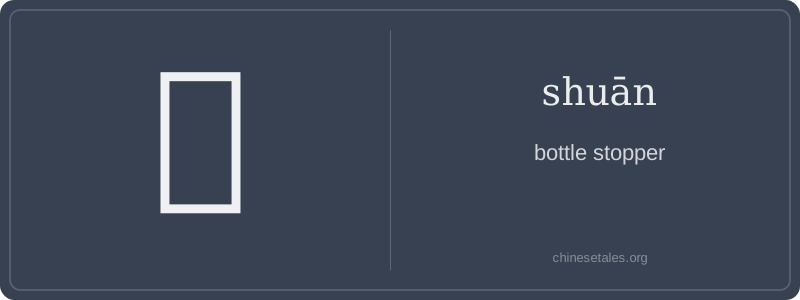
The earliest form of 栓 appears in Han dynasty seal script as a stylized image of a wooden post (木) with a horizontal bar crossing it — like a crude but unmistakable door bolt jammed across a timber frame. Over centuries, the bar evolved into the top component (a variant of 冖, ‘cover’), and the lower part solidified into 木, the wood radical. By the Tang dynasty, the shape stabilized into today’s ten-stroke form: + 八 + 木 — where 八 subtly suggests the ‘spreading’ or ‘locking’ action of the bolt’s crossbar gripping the frame. Every stroke serves function: the cover-like top presses down, the ‘eight’ hints at division or sealing, and the wood base grounds it in material reality.
This visual logic directly shaped meaning. In classical texts like the *Rites of Zhou*, 栓 referred specifically to the wooden peg inserted into a gate mechanism to lock it overnight — a symbol of security and authority. Later, the concept extended metaphorically: a river dam became a 水栓 (shuǐ shuān), a medical obstruction a 血栓 (xuè shuān). Even today, when doctors diagnose a pulmonary embolism, they say ‘a 栓 has broken loose’ — linking ancient carpentry to life-threatening physiology. The character didn’t just describe objects; it encoded a worldview where stability came from firm, wooden, irreversible fastening.
At its heart, 栓 (shuān) is all about *securing something tightly* — not just corking a bottle, but locking, fastening, or even blocking off a passage. Think of it as the ‘clunk’ sound of a heavy wooden latch dropping into place: solid, deliberate, slightly rustic. Though modern dictionaries list ‘bottle stopper’ first, native speakers most often encounter it in mechanical or medical contexts — like a ‘blood clot’ (血栓, xuè shuān) or a ‘valve’ on old-fashioned plumbing. It’s never used for modern screw caps or plastic lids; that’s where learners trip up — expecting it for any kind of closure, when it actually implies *wooden rigidity*, *physical obstruction*, or *biological blockage*.
Grammatically, 栓 is almost never a standalone verb. You won’t say ‘I shuān the bottle’ — instead, it appears as a noun in compounds (e.g., 门栓, mén shuān, ‘door bolt’) or as the core of technical terms (e.g., 血栓形成, xuè shuān xíng chéng, ‘thrombosis’). It rarely takes aspect particles (了, 过) or reduplication. Its presence signals seriousness: if someone mentions a 栓, something’s either firmly shut — or dangerously blocked.
Culturally, this character carries echoes of pre-industrial China: thick wooden doors secured with iron-reinforced wooden bolts, wine jars sealed with bamboo-and-clay stoppers, and traditional medicine’s emphasis on unobstructed flow (so a blood 栓 is literally a ‘life-flow blocker’). Learners mistakenly write it as 拴 (shuān, ‘to tie’) — an easy slip since both share pronunciation and the idea of securing — but 拴 is flexible (ropes, shoelaces), while 栓 is rigid and structural. That wooden radical 木 isn’t decorative: it’s the character’s backbone, literally and etymologically.