栭
Character Story & Explanation
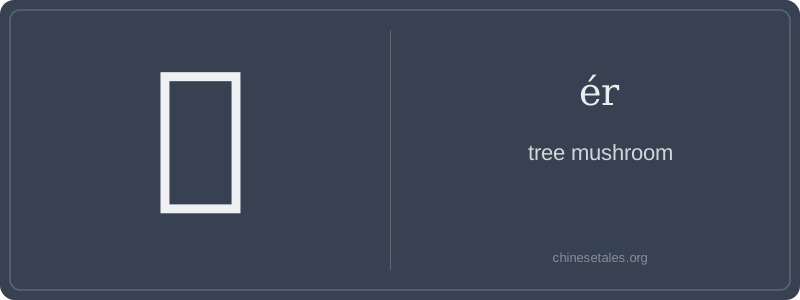
The earliest form of 栭 appears in seal script (zhuànshū), where it combines two clear elements: the radical 木 (mù, 'tree') on the left — unmistakably depicting roots, trunk, and branches — and 台 (tái) on the right, which in ancient forms resembled a raised platform or altar-like structure. Over time, 台 simplified into its modern shape, but its original sense carried connotations of 'elevation' or 'emergence' — perfectly capturing how mushrooms erupt upward from bark. No oracle bone form survives, but bronze inscriptions suggest it was already used by the Warring States period to denote fungi whose life began *in* wood, not beside it.
This visual logic persisted: 木 anchors it to arboreal origin, while 台 subtly implies emergence, growth, and even ritual significance — in early Chinese thought, tree fungi were seen as liminal beings, neither plant nor animal, thriving at the boundary between life and decay. The Qí Mín Yào Shù (6th c. CE agricultural manual) mentions 槲栭 (hú ér) — oak-grown 栭 — as both edible and medicinal. Its enduring rarity isn’t due to obscurity, but precision: 栭 never meant 'any mushroom' — only those intrinsically bound to trees, a nuance still honored in modern mycology texts.
At first glance, 栭 (ér) looks like a quiet, obscure character — and it is! It means 'tree mushroom', specifically the kind that grows on living or decaying wood, like oyster mushrooms or certain bracket fungi. Unlike common food words like 菌 (jūn, 'mushroom') or 蘑菇 (mógu, 'mushroom'), 栭 carries a distinctly classical, botanical, even poetic weight. You won’t hear it in daily conversation or restaurant menus; it lives in herbal texts, ancient poetry, and mycological treatises — think of it as the 'Latin name' of mushrooms in Chinese.
Grammatically, 栭 functions almost exclusively as a noun, often appearing in compound terms (like 栭菌 or 槲栭) rather than alone. It rarely takes modifiers directly — you wouldn’t say *大栭 or *新鲜栭 naturally. Instead, it pairs with classifiers like 种 (zhǒng, 'kind') or appears after descriptive nouns: 槲树上的栭 (hú shù shàng de ér, 'the 栭 growing on oak trees'). Learners sometimes misread it as ér (like 儿), but its pronunciation is identical — no tone shift — yet its meaning is utterly unrelated to 'child' or 'son'. That homophone trap is real!
Culturally, 栭 evokes a Daoist-tinged reverence for wild, spontaneous growth — mushrooms as quiet emissaries of forest vitality. In the Shuō Wén Jiě Zì (121 CE), Xu Shen defined it as 'fungus born from trees', underscoring symbiosis over cultivation. Modern learners rarely encounter it — and when they do, it’s usually in literary translation or TCM herb lists. Mistake it for 儿 or 耳? You’ll accidentally conjure 'ears' or 'children' on your oak tree — a charming but botanically disastrous error.