栵
Character Story & Explanation
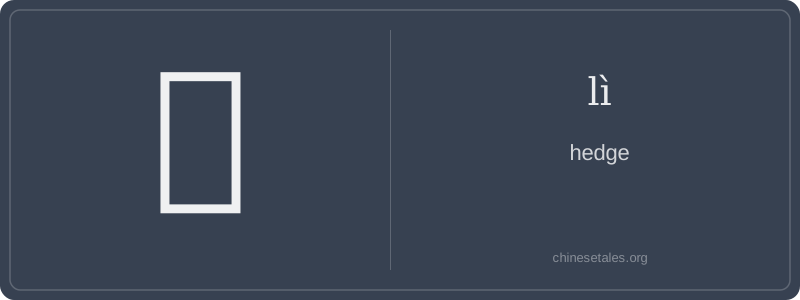
The earliest form of 栵 appears in bronze inscriptions as a stylized depiction of two parallel rows of shrubs or stakes flanking a path — the left side showing clustered plant-like strokes (木 radical), the right side originally resembling 立 (standing) but evolving into 刂 (knife/blade radical), suggesting trimmed, controlled growth. Over centuries, the wood element solidified as the left-side 木, while the right evolved from 立 + 刂 into today’s 利-like shape — not 'profit', but 'cut-to-shape': a hedge deliberately maintained.
This visual logic anchored its meaning: a hedge isn’t accidental underbrush — it’s vegetation managed *as* a boundary. The character appears in the *Shijing* (Classic of Poetry), describing rural borders where 'the 栵 grows thick beside the dyke', symbolizing communal land stewardship. Its enduring shape — wood + disciplined cutting — quietly tells a story of harmony between human intention and natural growth: not domination, but careful coexistence within defined space.
At first glance, 栵 (lì) feels like a quiet, almost forgotten word — it means 'hedge', but not the tidy boxwood borders of English gardens. In classical Chinese, it evokes wild, thorny, boundary-defining shrubs that grow along field edges or village perimeters: functional, slightly unruly, and deeply rooted in agrarian life. It carries a subtle sense of natural demarcation — not walls, not fences, but living lines drawn by growth and terrain.
Grammatically, 栵 is almost exclusively a literary noun, rarely used alone in speech. You’ll find it in compound nouns like 栵篱 (lì lí) or in poetic phrases describing landscape boundaries — think 'the rustling 栵 at the eastern ridge' — never in casual conversation like 'I pruned the hedge'. Learners sometimes misread it as lǐ or nì due to its rareness and visual similarity to other characters, but its pronunciation is firmly lì (fourth tone), echoing the crisp, sharp sound of snapping dry twigs.
Culturally, 栵 reveals how classical Chinese encodes ecology into language: not just 'plant' or 'barrier', but a specific kind of dense, low-growing, boundary-keeping shrub — one that implies stewardship, seasonal change, and quiet territoriality. Modern speakers rarely use it; mistaking it for more common characters like 利 or 立 is the #1 error — both look similar at a glance but mean 'profit' and 'stand', respectively. That’s why context is everything: if you see 栵 in a Tang poem, it’s not about finance or posture — it’s about the wind moving through thorny green hedges at dusk.