桅
Character Story & Explanation
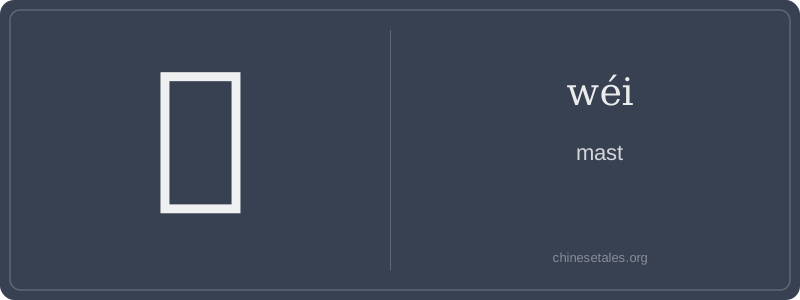
The earliest form of 桅 appears in seal script (around 200 BCE), where it clearly combines 木 (mù, 'tree/wood') on the left and 危 (wēi, 'dangerous, high') on the right. The 木 radical signals its material origin — masts were always made of sturdy timber, often pine or fir. The right side 危 originally depicted a person (人) atop a cliff (厃), conveying height and peril — perfectly capturing how a towering mast could sway dangerously in stormy seas. Over time, the top of 危 simplified from 厂 + 人 to the modern shape, while the 木 radical stayed firmly grounded, anchoring the character’s meaning in wood and structure.
This visual logic held steady across dynasties. In the Book of Songs (Shījīng), early references to 'tall poles on boats' used other characters, but by the Tang and Song dynasties, 桅 became standard in naval texts and shipbuilding manuals. Its dual nature — wood + danger — also subtly reinforced Confucian values: even in daring exploration, safety relied on solid craftsmanship (wood) and respectful awareness of risk (危). When you see the 10 strokes today, you’re looking at over two millennia of maritime wisdom distilled into one precise, balanced character.
Think of 桅 (wéi) as the 'Eiffel Tower of the sea' — not because it’s French, but because it’s a tall, proud, wooden spine rising from a ship’s deck, holding sails aloft like steel girders hold up Paris. In Chinese, it’s exclusively nautical: no metaphorical 'masts' for ambition or corporate 'flagship initiatives' — if you say 'his career is a mast,' native speakers will picture a confused sailor on dry land. It’s a concrete, technical noun, almost always paired with measure words like 根 (gēn, for long thin objects) or in compound terms like 桅杆 (wéi gān).
Grammatically, 桅 rarely stands alone. You’ll see it in descriptive phrases ('高耸的桅') or as part of ship-related vocabulary — never as a verb or adjective. Learners sometimes misread it as wěi (third tone) due to tone confusion, or worse, mistake it for 伟 (wěi, 'great'), leading to hilariously grandiose boat descriptions ('great mast' instead of just 'mast'). Also, it’s almost never used in spoken Mandarin outside maritime contexts, documentaries, or historical novels — so don’t drop it at your local dumpling shop.
Culturally, 桅 evokes China’s Ming dynasty treasure fleets and Zheng He’s voyages — not just ships, but symbols of exploration, diplomacy, and quiet maritime power. Modern usage is rare, making it a 'living fossil' character: preserved in dictionaries and naval manuals, but seldom heard. That rarity means learners who master it gain instant credibility — like knowing the name of the keel on a yacht. Just remember: this isn’t a poetic word — it’s engineering poetry carved in wood.