桉
Character Story & Explanation
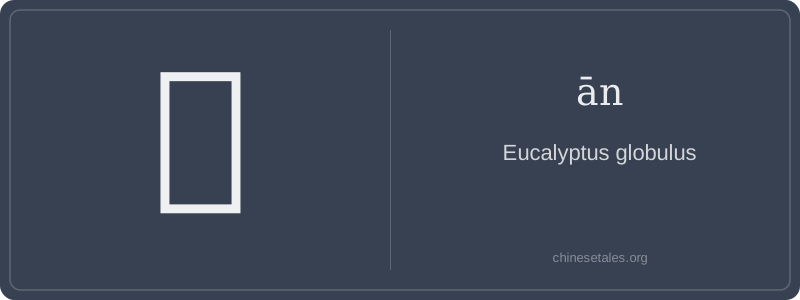
The character 桉 first appeared in seal script during the Qin dynasty — not as a pictograph, but as a phono-semantic compound. Its left side, 木 (mù), is the 'tree' radical — unmistakably visual: a stylized trunk with branching roots and canopy. Its right side, 安 (ān), originally depicted a woman (女) under a roof (宀), symbolizing safety and stability. When combined, the shape suggests 'a tree whose presence brings calm' — fitting, given how eucalyptus oil was later used for respiratory relief. Over time, strokes simplified: the woman became 口 (mouth) + 女 (in clerical script), then further abstracted into today’s 安 — all ten strokes now flowing cleanly: four for 木, six for 安.
This character didn’t exist in Classical Chinese — eucalyptus arrived in China only in the 1910s via Australian botanists. So 桉 is a modern coinage (early Republican era), deliberately built from ancient components to feel native. The choice of 安 as the phonetic wasn’t random: its meaning of 'calm' subtly echoes the tree’s soothing aroma and medicinal use in folk remedies. Though absent from pre-modern texts, 桉 now appears in government forestry bulletins and TCM pharmacopeias — a perfect example of how Chinese absorbs foreign concepts by dressing them in classical clothing.
Imagine walking through a sun-drenched botanical garden in Kunming, where the sharp, medicinal scent of eucalyptus hits your nose before you even see the trees — tall, silver-barked, and whispering in the wind. That’s 桉 (ān): not just any tree, but specifically the blue gum eucalyptus (Eucalyptus globulus), imported to China in the early 20th century and now deeply woven into southern Chinese ecology and medicine. In Chinese, 桉 is almost exclusively a noun — always referring to the tree or its derivatives (oil, leaves, timber). You’ll never say ‘I 桉’ or ‘he 桉ed’; it doesn’t verbify. It’s a quiet, technical word: precise, botanical, and rarely used in casual speech — which is why learners often overuse it (e.g., saying 桉树 for *any* eucalyptus, when only E. globulus qualifies) or underuse it (missing that it’s the *only* standard term for this species).
Grammatically, 桉 appears most often in compound nouns like 桉树 (ān shù, 'eucalyptus tree') or 桉叶油 (ān yè yóu, 'eucalyptus oil'), rarely alone. It’s also common in scientific or agricultural contexts — think forestry reports or traditional pharmacy labels. Unlike English ‘eucalyptus’, which can be countable or uncountable, 桉 is always singular and unmarked for number; you’d say 一棵桉树 (yī kē ān shù, 'one eucalyptus tree'), never *两桉*.
Culturally, 桉 carries a subtle duality: it’s both an ecological success story (planted widely for soil conservation and timber) and a mild controversy — some ecologists warn about its water consumption and allelopathic effects. Learners sometimes misread it as 安 (ān, 'peace') due to identical pronunciation and similar tone, leading to hilarious mistranslations like 'peace tree' instead of 'eucalyptus'. Remember: 桉 has wood (木) — it’s literal, botanical, and rooted in the earth.