桕
Character Story & Explanation
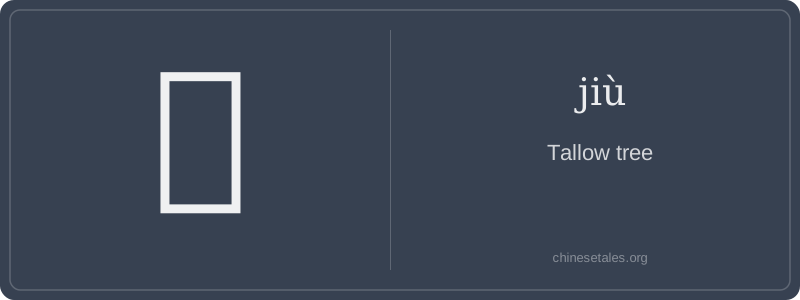
The earliest form of 桕 appears in Han dynasty clerical script, not oracle bone — because it’s a relatively late coinage, born from the need to name a culturally significant local tree. Its left side 木 (mù, 'tree') anchors it firmly in the botanical realm, while the right side 久 (jiǔ, 'long time') was chosen phonetically — not for meaning, but because early Middle Chinese pronunciation of 桕 closely matched 久. Visually, the ten strokes evolved cleanly: 木 (4 strokes) + 久 (6 strokes), with 久’s top horizontal stroke shortening and its curved hook tightening into today’s compact form — no radical deformation, no lost elements, just elegant phonetic borrowing.
Over centuries, 桕’s meaning stayed remarkably stable — always referring to the tallow tree — yet its cultural resonance deepened. Tang and Song poets like Wang Wei and Fan Chengda mentioned it in passing to evoke southern autumn stillness; Ming agricultural manuals praised its drought resistance and oil yield. Interestingly, the character’s visual logic reinforces its identity: 木 + 久 suggests a 'tree that endures' — fitting, since tallow trees thrive on poor soil and live over 100 years. Unlike characters that shifted meaning dramatically (e.g., 走 once meant 'run'), 桕 has remained faithfully rooted — both botanically and orthographically.
At first glance, 桕 (jiù) seems like a botanical footnote — just 'tallow tree' — but it’s a quiet time capsule of Chinese ecological memory. This isn’t some generic ornamental shrub: the tallow tree (Triadica sebifera) was historically prized for its waxy seeds, used to make candles, soap, and lamp oil in pre-industrial China. Its presence in texts evokes rural self-sufficiency, seasonal labor (harvesting in late autumn), and even folk medicine — so while modern learners rarely encounter 桕 outside botany or regional literature, native speakers associate it with warmth, utility, and quiet resilience.
Grammatically, 桕 behaves like most noun-classifier nouns: it almost always appears in compounds (e.g., 桕树, 桕油) or with modifiers (老桕树, 山边的桕). You’ll almost never see it bare — unlike common trees like 松 or 柳, it lacks standalone idiomatic force. A frequent learner mistake is overgeneralizing it as ‘any white-barked tree’; but 桕 specifically refers to Triadica, not the unrelated *Sapium* (sometimes mislabeled in older English sources) — and crucially, it’s never used metaphorically like 梅 (plum blossom = perseverance).
Culturally, 桕 carries subtle regional weight: it flourishes in southern China (Jiangsu, Zhejiang, Sichuan), where its fiery red autumn foliage and clusters of white seed-coated fruit made it a quiet staple of classical landscape poetry — though rarely the star. Learners often misread it as jiǔ (like 酒) due to tone confusion, or conflate it with 咎 (jiù, 'blame') because of identical pronunciation — but there’s zero semantic overlap. Remember: 桕 grows; 咎 weighs.