桲
Character Story & Explanation
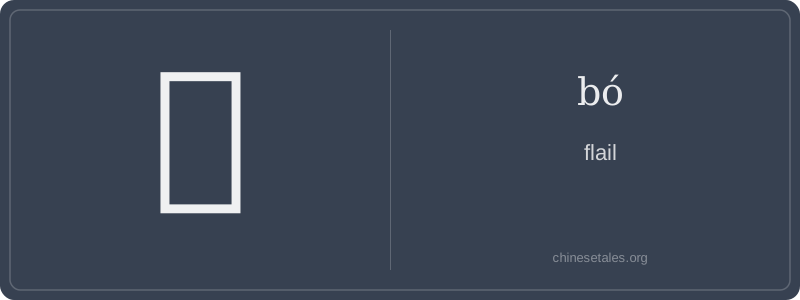
The earliest form of 桲 isn’t found in oracle bones (too rare for such a specialized tool), but bronze inscriptions and Han dynasty steles show its evolution clearly: originally, it depicted a vertical wooden handle (丨) topped by a rounded, weighted head connected by a flexible joint — rendered as a simplified loop or curve. Over centuries, this head became stylized into the 包 component, while the 木 radical anchored its material identity. By the Tang dynasty, the structure stabilized into today’s 11-stroke form: the left 木 unmistakably tree/wood, the right 包 — with its top dot, curved ‘wrapping’ stroke, and bottom ‘foot’ — visually mimicking the flail’s hinge-and-swing mechanics.
Its meaning remained remarkably stable: always the threshing flail, never broadened to ‘club’ or ‘bat’. Unlike many characters that semantically drifted, 桲 stayed tethered to one concrete object — a testament to how deeply agrarian vocabulary was codified in early Chinese writing. You’ll find it in the *Qimin Yaoshu* (540 CE), China’s oldest complete agricultural encyclopedia, where it appears alongside diagrams of grain processing tools. The character doesn’t symbolize struggle or chaos — though English ‘flail’ does — it’s purely technical, neutral, and precise: wood in motion, purpose-built.
Let’s crack 桲 (bó) like a linguistic nut: it’s not about trees — despite the 木 (wood) radical — but about *forceful, rhythmic striking*. The right side 包 (bāo) isn’t ‘package’ here; it’s a phonetic loan (ancient pronunciation closer to *bó*), and its curved enclosure evokes the looping motion of a flail — that two-part agricultural tool where a flexible joint lets the striking end swing freely. So 木 + 包 = ‘wooden tool with a swinging, enclosed head’. This character is hyper-specific: it names only the traditional flail (not modern hammers or bats), and appears almost exclusively in historical, literary, or dialectal contexts — never in daily conversation or HSK materials.
Grammatically, 桲 functions only as a noun — no verbs, adjectives, or compounds in standard modern usage. You’ll see it in phrases like 桲子 (bó·zi), meaning ‘flail’, or in classical descriptions of threshing grain. Learners might mistakenly try to use it as a verb (‘to flail’) — but Chinese uses 手舞足蹈 (shǒu wǔ zú dǎo) or 挥舞 (huīwǔ) for that. Also, don’t confuse it with 簸 (bò) — which means ‘to winnow’, another grain-processing action, but with a bamboo basket, not a wooden flail.
Culturally, 桲 is a quiet relic of pre-industrial agrarian life. Its rarity today makes it a ‘time capsule’ character — appearing in Tang dynasty poetry describing rural labor or Ming-era farming manuals. Mistake-wise, learners often misread its radical as 口 or forget the dot in 包, writing it like 抱. But remember: no arms are hugging here — just wood and motion. It’s a fossilized word, preserved not by frequency, but by precision.