桴
Character Story & Explanation
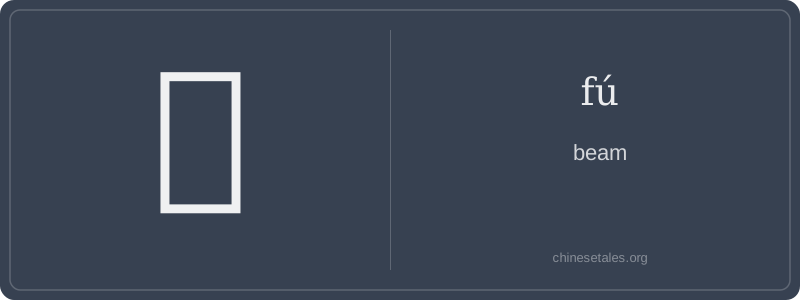
The earliest form of 桴 appears in bronze inscriptions as a stylized drawing: two vertical lines (pillars) with a thick, straight horizontal bar bridging them — unmistakably a beam resting across supports. Over centuries, the pillar strokes simplified into the 木 (mù, ‘tree/wood’) radical on the left, anchoring its material identity, while the right side evolved from a simple horizontal line into the complex component 孚 (fú), originally depicting a hand holding a child (symbolizing trust and bearing weight). By the seal script era, the structure was fixed: 木 + 孚 — wood that bears responsibility, literally and figuratively.
This visual logic shaped its meaning: not just any wood, but structural wood — the silent crossbar that holds architecture together. In the Book of Rites (Lǐjì), 桴 appears in descriptions of ancestral temple construction, where beams were ritually named and consecrated. Its pairing with 孚 (also meaning ‘to hold true’, ‘to be trustworthy’) deepened its resonance: a beam must be true, unwavering, faithful to its function. Even today, when restorers rebuild a Song-dynasty pavilion, they refer to the central crossbeam as the 主桴 (zhǔ fú, ‘master beam’) — honoring both engineering and ethos.
Think of 桴 (fú) as the 'I-beam' of classical Chinese — not the modern steel kind, but the hand-hewn wooden beam that held up ancestral halls and temple roofs in ancient China. Unlike generic terms like liáng (梁) or gān (杆), 桴 carries a quiet dignity: it’s a horizontal support beam, often specifically one that rests *across* pillars to bear weight — like the lintel over a gate or the crossbeam beneath a roof’s ridgepole. It feels architectural, precise, and slightly archaic: you’ll rarely hear it in daily conversation, but it appears with reverence in classical texts and restoration documents.
Grammatically, 桴 is almost always a noun and rarely takes modifiers — no ‘very beam’ or ‘more beam’. It pairs naturally with measure words like yī gēn (一根) or yī tiáo (一条), but more elegantly with classical ones like yī jià (一架, ‘a frame of’) or yī fú (一桴, poetic repetition of the character itself). You’ll see it in phrases like 桴木 (fú mù, ‘beam timber’) or 桴架 (fú jià, ‘beam framework’), never as a verb or adjective — unlike English ‘beam’, which can mean to smile radiantly. A common learner trap? Assuming it’s interchangeable with 梁 (liáng); but 梁 is broader (any load-bearing horizontal member), while 桴 implies structural centrality and symmetry — think of it as the ‘keystone beam’.
Culturally, 桴 echoes Confucian ideals of balance and quiet strength: unadorned, functional, essential yet invisible unless missing. Modern writers sometimes use it metaphorically — ‘the 桴 of tradition’ — evoking unseen foundational support. Learners mistakenly write it as 浮 (fú, ‘to float’) due to identical pronunciation and similar stroke count; but 浮 has 氵 (water) on the left, betraying its liquid nature — a classic homophone hazard where context is your only lifeline.