梠
Character Story & Explanation
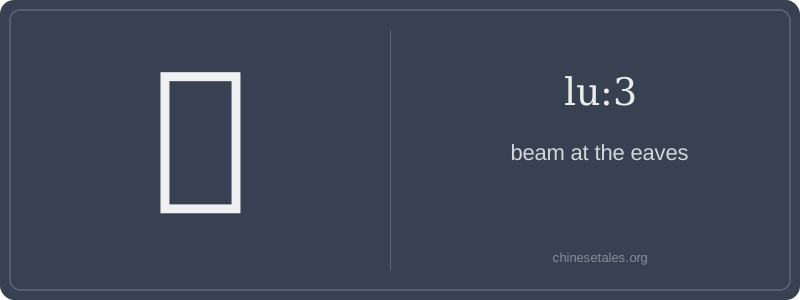
The earliest form of 梠 appears in Han dynasty seal script, where the left side was unmistakably 木 (wood), and the right resembled an early variant of 留—a simplified pictograph showing a 'field' (田) with a 'knife' (刀) beside it, symbolizing 'to detain' or 'hold in place'. Over centuries, the knife morphed into the 'stopping' component 止, then further stylized into today’s 留. Crucially, the top part of 留 (the 'sweat-inducing' radical 亠 + 田) visually echoed the layered, overlapping rafters seen under eaves—making the character itself a subtle sketch of architecture in motion.
By the Tang and Song dynasties, 梠 was standard in carpentry manuals like the *Yingzao Fashi* (1103 CE), where it denoted the *chūn liáng*—the 'spring beam', named for its outward 'leaping' projection. Poets like Du Fu used it metaphorically: 'The old temple’s 梠 sags, yet still holds the rain'—turning structural decay into quiet resilience. Its visual duality—wood + 'to remain'—mirrors Confucian ideals: strength isn’t dominance, but steady, sheltering presence. Even today, conservation architects in Suzhou gardens pronounce 梠 with reverence—not as a relic, but as a reminder that precision in naming preserves memory in timber.
Let’s unpack 梠 (lǔ) like a linguist archaeologist: it’s a rare, architectural character meaning 'beam at the eaves' — specifically the horizontal timber that projects from the roof edge to shield walls from rain. Visually, it’s a left-right compound: the wood radical (木) on the left screams 'this is about timber or trees', while the right side, 留 (liú), isn’t just phonetic—it’s deeply semantic too. 留 means 'to stay, to remain', and in ancient construction, these eave beams were *left projecting* deliberately, 'lingering' beyond the wall line. So 梠 isn’t just any beam—it’s the one that *stays out*, doing its protective duty.
Grammatically, 梠 is almost exclusively a noun and appears only in classical, literary, or technical architectural contexts—never in daily speech or modern textbooks. You’ll find it in phrases like 檐梠 (yán lǔ, 'eave beam') or in historical building records, but never in 'I need a new roof'. Learners sometimes try to use it as a verb ('to beam out') or confuse it with common words like 楼 (lóu, 'building')—but no, 梠 has zero verbal usage and zero colloquial life. It’s a fossil word, preserved in texts, not conversation.
Culturally, 梠 reveals how precisely Chinese architecture names every structural element—no English equivalent exists for this specific beam type. Mistaking it for 梁 (liáng, 'main roof beam') is common, but that’s a load-bearing central member, while 梠 is decorative *and* functional, often carved or painted. Its rarity means even many native speakers haven’t encountered it outside classical poetry or heritage restoration documents—so if you spot it, you’re reading something beautifully precise and old.