梣
Character Story & Explanation
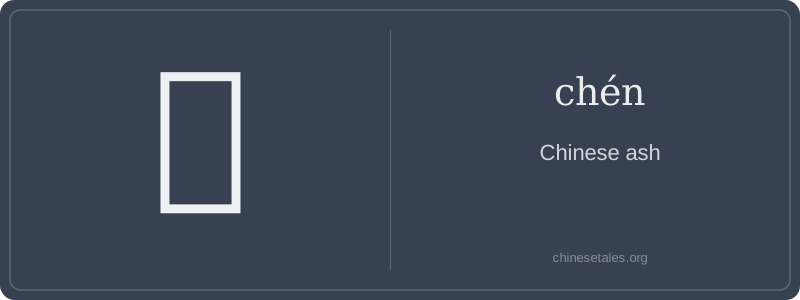
The earliest form of 梣 isn’t found in oracle bones (too rare for trees), but bronze inscriptions reveal its logic: a left-side 木 (tree) radical anchoring the idea of 'wood', paired with 参 (cān) — later simplified to 申 — which originally depicted lightning or celestial expansion, symbolizing the ash’s rapid vertical growth and deeply furrowed, 'crackling' bark. Over centuries, 参 lost its three dots and streamlined into 申, while 木 retained its classic four-stroke trunk-and-branches shape. The modern 11-stroke 梣 emerged by the Han dynasty: 木 (4 strokes) + 申 (7 strokes), with the horizontal stroke of 申 cleanly crossing the vertical, mimicking how ash bark splits into diamond-shaped ridges.
This visual metaphor deepened over time: in the Tang dynasty, poets used 梣 indirectly — praising ‘sturdy, springy wood’ in bow-making odes — while the character itself stayed technical. By the Song, herbalists linked 申’s ‘expanding’ energy to the tree’s medicinal action: its bitter bark ‘spreads’ qi to clear stagnation. Even today, the crossbar in 申 feels like a taut bowstring stretched across the wooden frame — a silent echo of millennia-old craftsmanship embedded in ink and stroke.
梣 is a quiet botanical specialist — it doesn’t shout like common characters (e.g., 人 or 大), but stands tall like the ash tree itself: slender, resilient, and deeply rooted in Chinese ecological vocabulary. Its core meaning is precise: not just any ash, but the native Chinese ash (*Fraxinus chinensis*), a deciduous hardwood prized for tool handles, furniture, and traditional medicine. You’ll almost never see 梣 alone in speech or writing — it’s strictly a noun, always embedded in compound words like 梣木 (chén mù, 'ash wood') or 白梣 (bái chén, 'white ash'). Unlike versatile radicals like 木 that appear in verbs (e.g., 林, 森), 梣 carries zero grammatical flexibility; no adjectives, no verbs, no reduplication — it’s a botanical proper name wearing bark as punctuation.
Learners often misread it as chēn (like 陈) or assume it’s interchangeable with 桦 (huà, birch) due to similar leaf shapes — a costly error when ordering timber or reading forestry reports. Another trap? Confusing its right-hand component 申 (shēn) with 甲 (jiǎ) or 由 (yóu); though they look alike, 申 carries the ‘stretching’ semantic thread that subtly echoes the ash tree’s upright, sinewy growth habit. In classical texts, 梣 appears rarely — mostly in Ming-Qing herbal manuals like *Bencao Gangmu*, where its bark is noted for clearing heat and dispelling wind-dampness.
Culturally, 梣 occupies a humble but vital niche: it’s the unsung timber behind ancient Chinese archery bows (its elasticity rivaled bamboo and mulberry) and the subtle flavor note in aged rice wine barrels. Modern usage remains technical — you’ll find it on nursery labels, botanical surveys, or environmental restoration plans — never in daily chat. If you encounter it, you’re either in a forest, a lab, or a very specific dictionary page.