梧
Character Story & Explanation
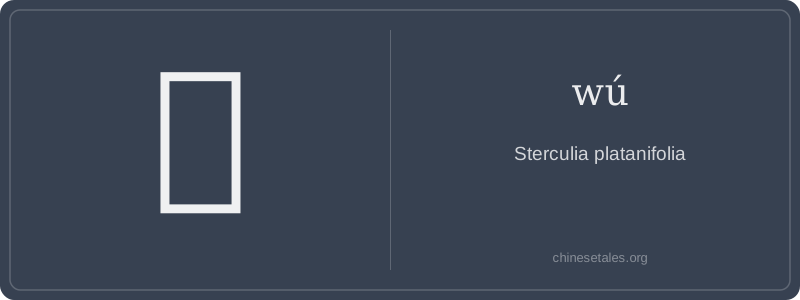
The earliest form of 梧 appears in bronze inscriptions around 1000 BCE as a compound pictograph: left side 木 (a stylized tree with roots and branches), right side 吾 — originally a phonetic component depicting a mouth (口) inside a weapon-like frame (五), representing self-reference ('I', 'we') in Old Chinese. Over centuries, the right side simplified from 吾’s complex bronze form into today’s clean 吾 (wú), preserving both sound and the sense of ‘belonging’ — as if the tree ‘belongs to us’ as a cultural anchor. Its 11 strokes balance precisely: four for 木, seven for 吾 — no extra flourishes, no ambiguity.
This character didn’t grow from observation alone — it grew from reverence. By the Warring States period, 梧桐 was already linked to auspiciousness in texts like the *Zuo Zhuan*, where noble conduct was compared to the upright growth of the wutong. The pairing with 桐 (tóng, phoenix tree) wasn’t accidental: 梧’s broad canopy shelters, while 桐’s fast growth signals renewal — together, they became yin-yang twins of moral ecology. Even today, calligraphers subtly elongate the final stroke of 吾 to echo the tree’s soaring trunk — a silent homage written in ink.
Think of 梧 (wú) as Chinese botany’s version of the 'sycamore' in English — not the American sycamore, but the majestic, broad-leaved Sterculia platanifolia: a tall, shade-giving tree native to southern China with heart-shaped leaves and distinctive star-shaped fruits. Unlike generic terms like 树 (shù, 'tree'), 梧 carries poetic weight — it’s rarely used alone in speech; you’ll almost always encounter it embedded in compounds like 梧桐 (wú tóng), where it functions as an inseparable lexical unit, not a free-standing noun. Trying to say *‘I planted a wú’* would sound as odd as saying *‘I planted a sycamore’* without specifying *‘tree’* — because 梧 isn’t just a name; it’s half of a cultural symbol.
Grammatically, 梧 is strictly bound — it never appears solo in modern usage except in botanical texts or classical poetry. You won’t see it as a subject or object in everyday sentences (e.g., no *‘梧很高’*). Instead, it pairs exclusively with 桐 to form 梧桐, a binomial term that behaves like a single noun: ‘The phoenix perches on the wutong’ (凤凰栖于梧桐). Learners often mistakenly treat 梧 as a standalone word or misread it as wǔ (third tone) — but its tone is firmly wú (second), echoing the ancient name for this sacred tree.
Culturally, 梧桐 isn’t just flora — it’s mythic infrastructure. In classical lore, the fenghuang (phoenix) only lands on the wutong, making it a metaphor for virtue attracting excellence. Modern learners sometimes overextend this symbolism — assuming any ‘noble tree’ qualifies as 梧, when in fact it refers specifically to Sterculia platanifolia (not the parasol tree or paulownia, despite folk confusion). Also, beware: in some regional dialects or older texts, 梧 may appear in place names (e.g., 梧州 Wúzhōu), but there it’s purely phonetic — unrelated to the tree meaning.