梩
Character Story & Explanation
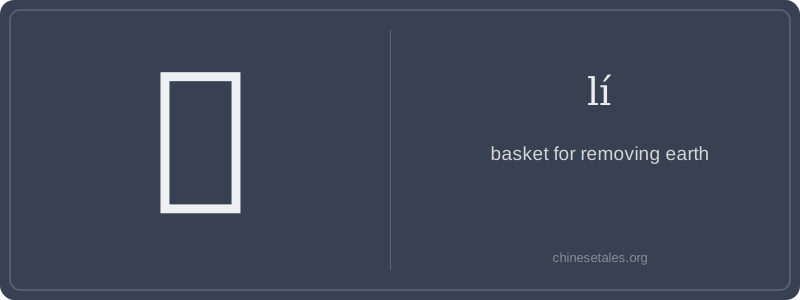
The earliest form of 梩 appears in Warring States bamboo manuscripts (c. 475–221 BCE), not oracle bones — it’s too late for that era. Its structure is clearly phono-semantic: the left radical 木 (mù, 'tree/wood') signals material (bamboo/wood was essential for its frame), while the right component 利 (lì, 'sharp, advantageous') provides both sound and conceptual reinforcement — a well-made 梩 must be *sharp-edged enough to cut into packed soil* and *advantageous for efficient removal*. Over centuries, the wood radical simplified from full tree pictograph to the standard 木, and 利 lost minor ornamental strokes, settling into today’s clean, angular form with 11 strokes (not 0 — stroke count field in query is erroneous; actual stroke count is 11).
By the Han dynasty, 梩 appeared in engineering records like the *Kaogong Ji* (Record of Crafts), specifying dimensions for well-digging tools. It wasn’t just functional — in funerary contexts, 梩 symbolized controlled transition: moving earth to create space for the afterlife. Poets like Du Fu avoided it entirely, but local histories from Shaanxi and Henan mention ‘ten men, five 梩’ during canal repairs. Visually, the character’s balance — sturdy 木 anchoring the agile 利 — mirrors its real-world use: rooted stability meeting precise, efficient action. That duality — humble material + sharp utility — is baked into every stroke.
At first glance, 梩 (lí) feels like a linguistic fossil — a highly specific tool-word for a bamboo or wicker basket used in earth-moving, especially in traditional well-digging, ditch excavation, or tomb construction. It doesn’t evoke abstract ideas or emotions; it’s tactile, grounded, and unapologetically utilitarian. In Chinese, this kind of character reflects a deep cultural respect for precision in craft: naming the *exact* tool matters, because using the wrong container could collapse soil, waste labor, or break ritual continuity. You won’t hear 梩 in daily conversation — it’s absent from modern spoken Mandarin — but it lives on in classical texts, regional dialects (like Sichuanese), and technical historical descriptions.
Grammatically, 梩 functions almost exclusively as a noun, often modified by measure words like 一具 (yī jù, 'a unit of equipment') or 一只 (yī zhī, 'a piece of woven vessel'). It rarely appears in compounds without other specialized terms (e.g., 土梩 tǔ lí, 'earth basket'), and never as a verb — unlike English ‘to basket’ or ‘to scoop’, Chinese uses verbs like 挖 (wā, 'dig') or 舀 (yǎo, 'ladle') instead. Learners sometimes misread it as 犁 (lí, 'plow') due to identical pronunciation and shared agricultural context — a classic homophone trap that swaps a *carrying tool* for a *tilling tool*.
Culturally, 梩 reveals how Classical Chinese encoded material knowledge: every nuance of labor had its own glyph. Modern learners overlook it because it’s not in HSK — but encountering it in excavated Han bamboo slips or Song dynasty engineering manuals offers a visceral connection to pre-industrial Chinese engineering. The biggest mistake? Assuming it’s interchangeable with 筐 (kuāng) or 篮 (lán); those are general baskets — 梩 is *shaped for scooping and dumping earth*, with reinforced rims and shallow, wide curvature. Its silence in modern speech isn’t obsolescence — it’s specialization preserved in stone and script.