梲
Character Story & Explanation
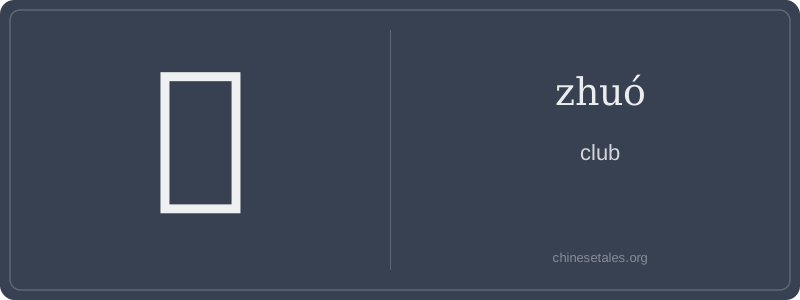
The earliest form of 梲 isn’t found in oracle bones—it first appears in Warring States bamboo slips and bronze inscriptions as a compound ideograph: the left side 木 (mù, 'tree/wood') clearly depicts a trunk with roots and branches, while the right side 卓 (zhuó) originally showed a tall stand or pillar (⺊ + 十 + 日 in early forms), symbolizing elevation and solidity. Over centuries, 卓 simplified, losing its top 日 component and compressing into today’s 卓 shape—so 梲 literally means 'wooden pillar' → 'heavy wooden implement.' The strokes evolved from thick, angular bronze script lines to the clean, balanced structure we see now: 木 anchoring the left, 卓 compactly stacked on the right.
Its meaning stabilized early: in the Zuo Zhuan, it appears in descriptions of border guards 'carrying clubs for night patrols'—not weapons per se, but tools of deterrence and authority. By the Han dynasty, 梲 was already archaic in spoken use but preserved in military manuals and legal texts to denote non-lethal force instruments. Interestingly, its visual form reinforces its meaning: the 木 radical grounds it in material reality, while 卓’s upright, unyielding shape mirrors the club’s vertical heft and immovable presence—no curve, no edge, just mass and intention.
Let’s crack 梲 (zhuó) like a linguistic nut: it’s not about fancy swords or martial arts scrolls—it’s the humble, heavy, blunt-force instrument: a club. Think oak stave, not ninja star. Its core feel is weighty, primitive, and functional—evoking force without finesse. In classical Chinese, it almost always appears as a noun, rarely verbified, and carries an archaic, literary gravity; you won’t hear it in daily chat or WeChat memes. It’s the kind of word that shows up in historical texts describing battlefield improvisation or ritual implements—not your local gym’s foam roller.
Grammatically, 梲 behaves like a monosyllabic noun with strong collocational preferences: it pairs with verbs like 持 (chí, 'to hold'), 执 (zhí, 'to grasp firmly'), or 砸 (zá, 'to smash')—never with modern action verbs like 'swing' or 'wield' unless translated poetically. You’ll see it in phrases like '持梲而立' (chí zhuó ér lì, 'standing holding a club'), where the structure feels frozen in time. Learners often misread it as a variant of 卓 (zhuó, 'outstanding') due to identical pronunciation and similar stroke rhythm—but semantically, they’re worlds apart: one is wood + blunt object, the other is 'a tall, elevated thing' (⺊ + 十).
Culturally, 梲 evokes early Zhou dynasty warfare and folk justice—less 'heroic weapon,' more 'last-resort tool.' It’s absent from Confucian virtue discourse (unlike 劍 jiàn, the cultured sword), and never romanticized in poetry. A common mistake? Assuming it’s interchangeable with 棍 (gùn, 'staff/rod')—but 棍 is neutral, modern, and everyday; 梲 is thick, dense, and charged with antiquity. Use it wrong, and your ancient general suddenly sounds like he’s holding a pool cue.