棩
Character Story & Explanation
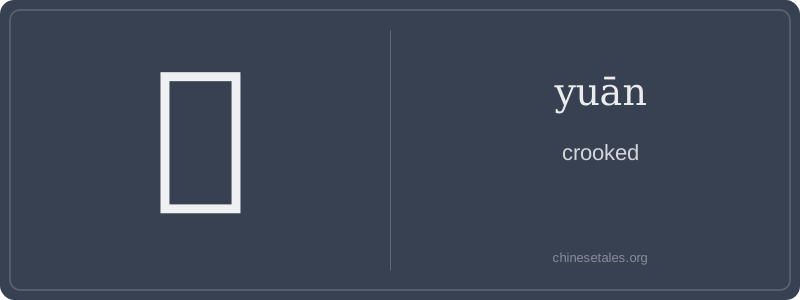
The earliest form of 棩 appears in Warring States bamboo slips — not oracle bones — as a highly stylized compound: the left side was originally 木 (mù, tree/wood), while the right side evolved from the ancient character 蜿 (wān), meaning 'to twist like a snake', which itself derived from a pictograph of a coiling serpent with undulating body strokes. Over centuries, the serpentine curves simplified into the modern 又 + 口 + 丶 structure on the right, losing its literal reptilian look but preserving the sense of contortion. The wood radical remained firmly anchored on the left, grounding the meaning in organic, structural deformation — not abstract deceit.
This visual logic shaped its semantic journey: from describing actual warped timber used in ancient architecture (where straight beams were prized but rare), 棩 came to symbolize principled nonconformity. In the *Zhuangzi*, Chapter 12 praises a 'crooked tree' (棩木) that escapes being cut down for lumber precisely because it’s useless to carpenters — thus surviving to embody wu-wei (effortless action). Its crookedness isn’t failure; it’s strategic integrity. Even today, calligraphers sometimes write 棩 with exaggerated right-side curves to visually echo its meaning — a rare case where modern script consciously mimics ancient intent.
Think of 棩 (yuān) as the Chinese linguistic equivalent of a bent fork — not broken, but deliberately, stubbornly askew. It doesn’t mean ‘broken’ or ‘damaged’ like 坏 (huài), nor does it imply moral corruption like 邪 (xié); instead, it captures a quiet, physical crookedness — a warped beam, a twisted vine, a path that refuses to go straight. In classical and literary usage, it’s almost exclusively descriptive of objects or natural forms: wood grain, mountain ridges, river bends. You won’t hear it in everyday speech — it’s too poetic, too precise, like using ‘sinuous’ instead of ‘curvy’ in English.
Grammatically, 棩 functions only as an adjective (never a verb or noun) and almost always appears before a noun, often in fixed descriptive phrases like 棩木 (yuān mù, 'crooked timber') or 棩曲 (yuān qū, 'twisted bend'). It rarely takes degree adverbs (e.g., *very* crooked) — saying 很棩 is unnatural; instead, classical compounds like 棩然 (yuān rán, 'crookedly, in a warped manner') are preferred. Learners often misapply it to people or behavior (e.g., *a crooked politician*), but that’s incorrect — for human dishonesty, use 邪恶 (xié’è) or 狡诈 (jiǎozhà), never 棩.
Culturally, 棩 carries subtle Daoist resonance: its crookedness isn’t a flaw but a sign of authenticity — think of gnarled old pines in ink paintings, revered precisely for their asymmetry and resistance to straightening. Mistaking it for a pejorative is a classic learner trap; in fact, classical texts like the *Zhuangzi* praise 棩木 as naturally wise, uncarved, and thus untamable by rigid Confucian norms.